

 Phoenix 24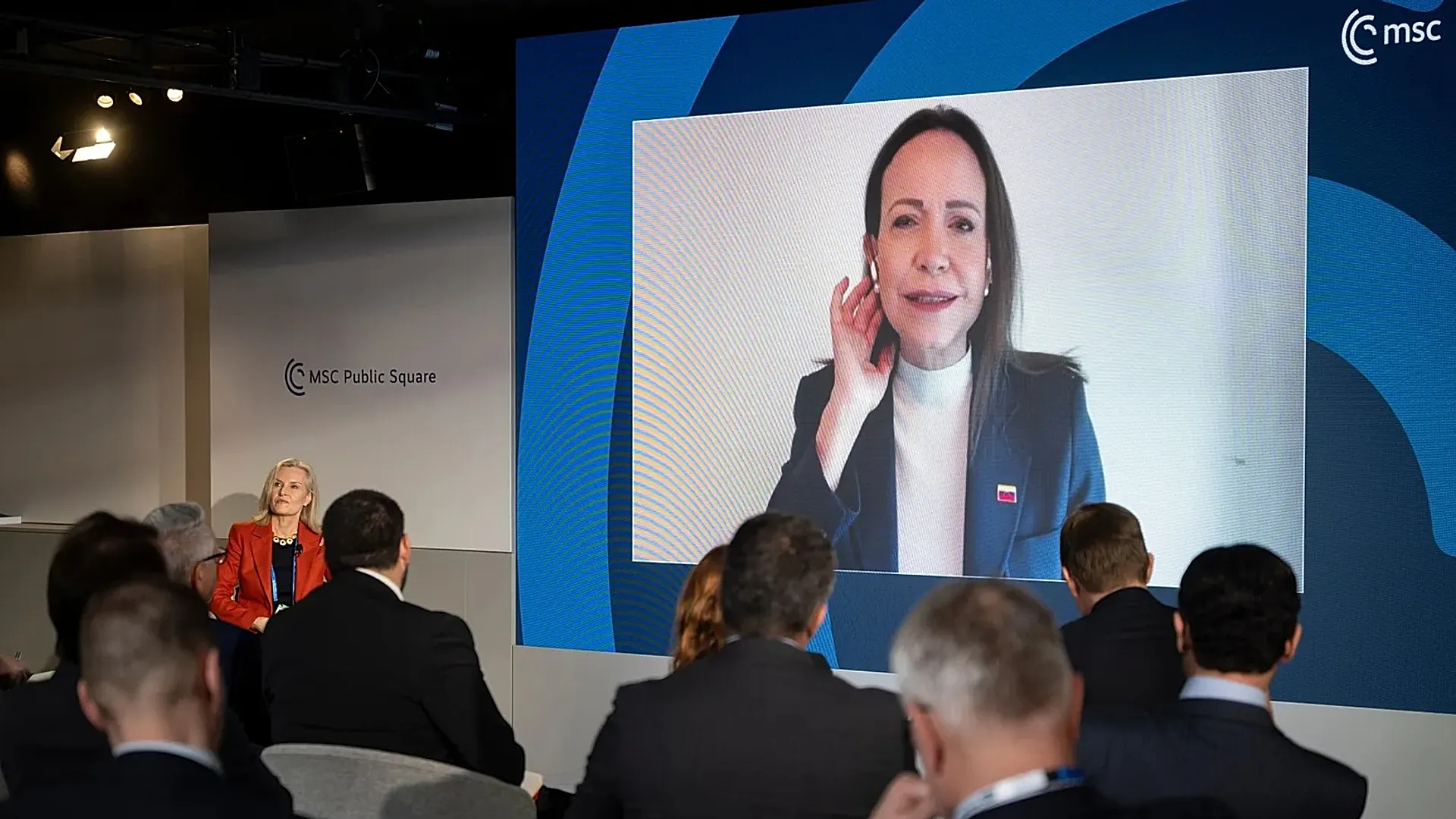
Peace prizes rarely survive the logic of power.
Munich, February 2026.
In a city built for calibrated language, María Corina Machado chose a line that breaks protocol. Speaking by video link at the Munich Security Conference, she defended her decision to hand the physical Nobel medal she received in 2025 to US President Donald Trump, presenting it as an act of justice and as a signal from a country she describes as systematically dismantled. Her core claim was blunt: she argued the United States was the only country willing to risk its own citizens’ lives for Venezuela’s freedom, and she connected that argument to the 3 January operation in Caracas in which US special forces captured Nicolás Maduro. The gesture is dramatic, but its deeper function is structural. It reframes a political transition as a security operation with an identifiable sponsor.
That matters because symbols do real work, especially in rooms where strategy is currency. In Munich, a Nobel medal is not only a personal artifact; it becomes a transferable claim to legitimacy aimed at audiences across capitals, parliaments, and security communities. Machado’s framing turns the medal into a compact between gratitude and expectation, thanking Trump not just for what she says has already occurred, but for what she suggests will happen soon. In that logic, the medal does not merely commemorate peace; it seeks to pre-authorize force as a morally defensible instrument. Once that boundary moves, every future debate about method becomes easier to shortcut.
Her argument also leaned on collapse as a strategic category, not merely a humanitarian one. She described a decade of institutional and social devastation and said that roughly a third of Venezuelans have been forced to leave, characterizing it as the largest migration crisis in the world today. Even without litigating the figure inside that panel, the pattern is familiar to the international system: when displacement becomes massive, it stops being an internal tragedy and becomes cross-border pressure. Neighboring states absorb fiscal and social strain, distant governments absorb political backlash, and illicit economies exploit the seams. In that environment, “stabilization” becomes a word that can justify almost anything.
The most consequential part of her remarks was the way she recoded the Venezuelan state as a security threat rather than a political adversary. She called the system that controlled the country a criminal regime and said it allied itself with major criminal forces abroad. That language is not decorative; it is procedural, because it invites a different toolbox. Once an actor is narrated as transnational crime, the policy menu expands to sanctions, asset seizures, intelligence cooperation, and special operations, all with a lower threshold for controversy. The story stops being primarily about ballots and starts being about targets.
Yet Munich is also the forum where legitimacy is argued in real time, and where precedents are quietly priced. The same European capitals that speak constantly about international law and sovereignty understand that exceptionalism rarely stays contained. If intervention can be publicly celebrated in one case, it can be repackaged elsewhere by other governments, under different conditions, and with less credible justifications. The silence that follows such moments is rarely agreement; it is calculation. Europe hears the promise of order, but it also hears the cost of endorsing a model that normalizes exceptions.
Machado tried to pre-empt the most obvious critique, the suspicion of quid pro quo. Asked what she expected in exchange for giving Trump the Nobel medal, she said she expected nothing specific, and described her objective as working with the United States while bringing other democratic countries into a reconstruction process for a nation with “enormous potential.” It is a careful answer, but it does not dissolve the underlying asymmetry. Transitions launched through external force tend to inherit external priorities, sometimes in energy, sometimes in security architecture, sometimes in institutional design. Even when no bargain is spoken, a bargain often arrives later, quietly, as a condition for continuity.
There is also a second layer of fragility: US domestic volatility. In Munich, Washington is never a single line; it is a battleground of factions. One camp reads the hemisphere through hard power and deterrence, another warns that such actions corrode the very rules the West claims to defend. That split is not academic. It determines continuity, funding, and the durability of commitments across election cycles and internal crises. A Venezuelan transition tethered to one leader’s appetite becomes structurally vulnerable, because the sponsor’s priorities can shift faster than institutions can be rebuilt.
Then comes the question of return, the detail that sounds personal but operates as strategy. Machado said she would go back to Venezuela as soon as possible, once she completes actions and objectives now underway, adding that she is engaging directly with international actors after being unable to leave the country for years. That admission reveals where part of the work is happening. Venezuela’s next phase is being shaped not only in domestic arenas but in external rooms, through diplomatic backchannels, security consultations, and coordination with governments that want stability while also managing reputational and legal risk. A return, in this context, is not merely a trip home; it is the closing of an external phase and the opening of a contested internal one.
The deeper tension is not whether a medal can be gifted. It is what kind of world is being rehearsed. When peace symbols are used to validate kinetic methods, the moral vocabulary of the system changes. “Liberation” and “tutelage” begin to blur, and sovereignty is rebuilt with fingerprints that are not entirely domestic. If Venezuela becomes a template, the template will be studied, adapted, and repeated. Munich did not merely host a speech; it hosted a precedent.
La narrativa también es poder. / Narrative is power too.