

 Phoenix 24

Fame turns setbacks into public verdicts.
Weatherford, February 2026.
Reports that Bella Hadid and Adan Banuelos had reconciled shortly before his arrest in Texas have pushed their private relationship into a public stress test. The core fact pattern being circulated is simple: a brief separation, signs of renewed closeness, then a legal incident that instantly reframes everything. In celebrity ecosystems, the sequence matters because audiences read timing as intent, even when real life is messier than any timeline. Outlets such as People and Cosmopolitan have described the relationship as back on track before the arrest, which makes the story feel less like a breakup aftermath and more like a fragile restart interrupted. Once a restart is visible, even indirectly, the public begins to demand coherence from two people who did not agree to live inside a narrative machine.

The arrest itself, as described in U.S. entertainment coverage, appears to be a low-level case, yet the optics are high-impact because public intoxication language carries immediate moral coding. A minor charge can still become a major reputational event when one partner is globally recognizable and the other’s career depends on discipline and trust signals. Banuelos is widely known within the cutting-horse circuit, where sponsorship and credibility matter, and a headline that implies loss of control clashes with the image required by elite competitive environments. This mismatch is what inflates the story, not necessarily the legal severity. The initial headline travels faster than any later administrative resolution, which is a structural asymmetry of attention, not a judgment about guilt.
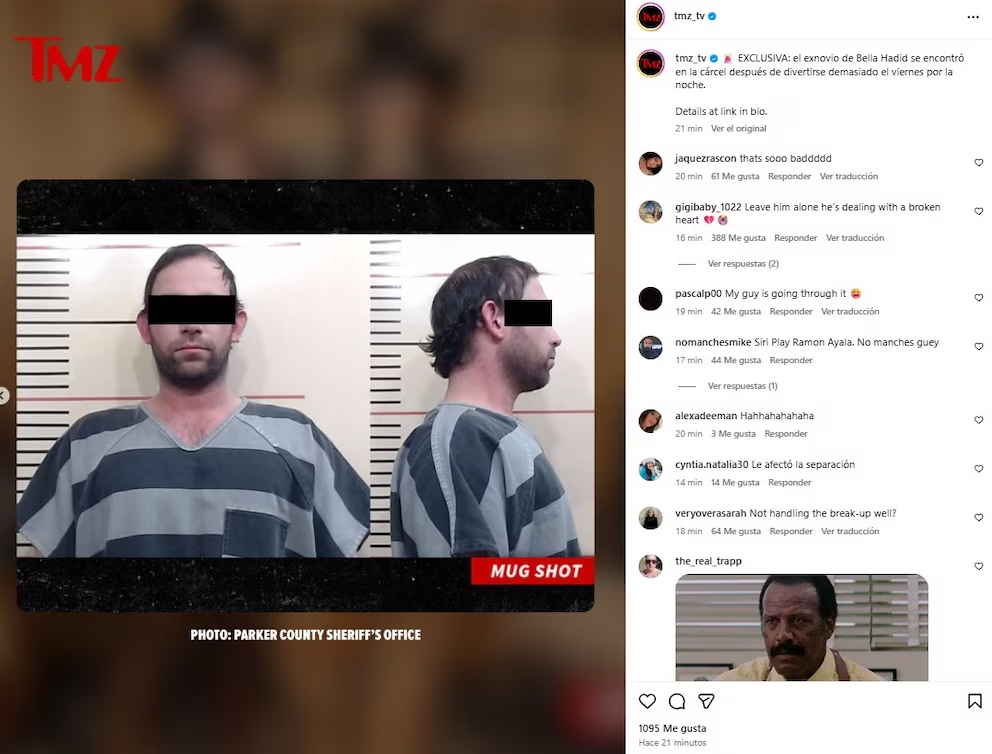
The reconciliation angle is the real accelerant because it shifts the audience from watching an individual incident to evaluating a couple’s choices. If the pair were already reconnecting, then the public reads the arrest through the lens of relationship judgment, not merely personal consequence. In practice, that often loads responsibility onto the more famous partner, because fame invites the expectation of managerial control over the entire situation. Hadid’s public arc in recent years has leaned toward wellness, boundaries, and self-protection, so any association with disorder can be interpreted as contradiction even when it is not. This is how celebrity culture turns a private life into a consistency audit. The relationship becomes less about affection and more about whether the story “matches” the persona.
A more sober reading is that this is a classic two-career strain amplified by a surveillance economy. Fashion and entertainment schedules pull Hadid toward global hubs, while Banuelos’s professional orbit is anchored in Texas and the competitive calendar of his sport. When people close to a couple describe distance and timing as stressors, it is rarely dramatic, it is cumulative. The point is not that long-distance love fails, it is that long-distance love requires stable routines and predictable windows, and celebrity work often destroys both. Under those conditions, short separations and quiet reconciliations are common, but they become abnormal when public attention treats them as plot twists.
The reputational challenge now is containment, not romance. If the couple responds with visible messaging, every word becomes a new surface for interpretation and counter-narrative. If they remain silent, silence itself becomes a canvas for projection, which is how the story sustains heat without new facts. U.S. entertainment media often treats that ambiguity as content, while European outlets tend to approach it as a cultural story about fame and privacy, and that difference in framing shapes how the incident is moralized. In either case, the incentives are misaligned with real recovery, because recovery is slow and boring while attention rewards immediacy. The most stabilizing move is usually consistency of behavior over time, not a single statement.

There is also a legal and ethical reason to keep the frame tight: celebrity news cycles can attach unrelated rumors to the main event, creating a fog where adjacent claims feel like confirmation. Responsible reporting separates verified booking information from social media amplification, and it avoids turning proximity into proof. The public rarely rewards that caution, but the individuals involved pay the price when rumor hardens into assumed fact. This is why the first days after an incident are the most reputationally dangerous, not because the truth changes, but because the narrative locks in early. Later corrections, dismissals, or routine closures rarely travel with equal velocity.
The larger pattern is that celebrity relationships now operate under scandal logic similar to politics. A minor legal incident becomes a proxy referendum on character, and a reconciliation becomes a referendum on judgment, even when neither conclusion is warranted by evidence. What actually determines the future of the relationship will be ordinary factors such as trust, boundaries, and the ability to reduce chaos, not the volume of headlines. Yet the headline cycle will keep running because it is powered by a simple mechanism: fame converts private complexity into public content. The most durable protection is not secrecy, it is time, because time is the one variable that drains attention when no new fuel is added.
Narrative is power too.
La narrativa también es poder.