

 Phoenix 24
Context turns fragments into meaning.
Mountain View, January 2026.
Google has introduced a feature inside Gemini known as personal intelligence, designed to help users extract key information from their own emails, photos and documents without relying on rigid keyword searches. The idea is simple in appearance but complex in execution: the system learns how to recognize relevant details across a user’s private data, as long as explicit permission is granted. Instead of forcing people to remember exact file names or phrases, Gemini is built to understand intent. It aims to answer questions the way a human assistant might, by connecting context rather than matching text literally.
The process begins with structured indexing of authorized data. Gemini does not simply copy emails or photos into a visible database. Instead, it creates abstracted metadata that represents entities, dates, locations and relationships. For example, a long email thread about travel can be transformed into a map of places, times and plans. Later, a user can ask something like “When am I supposed to be in Lisbon?” and receive a synthesized answer based on that internal structure.
With photos, the system uses multimodal analysis to connect visual content with language. Images are interpreted through patterns that identify objects, people, places and documents when allowed by the user. These features are then tagged with time and context. That makes it possible to ask questions such as “Show me pictures from the conference last October” or “Find the image with my passport.” The search is semantic, not literal, which means it depends on meaning rather than exact labels.
Handling ambiguity is one of the most difficult parts of this design. Many emails contain phrases like “next week” or “on Tuesday” without clear dates. Gemini tries to resolve these by comparing messages with calendar data and surrounding conversations. It uses probabilistic reasoning to guess the most likely interpretation. This makes interactions feel conversational, but it also introduces risk if context is misunderstood. The system therefore has to balance confidence with caution.
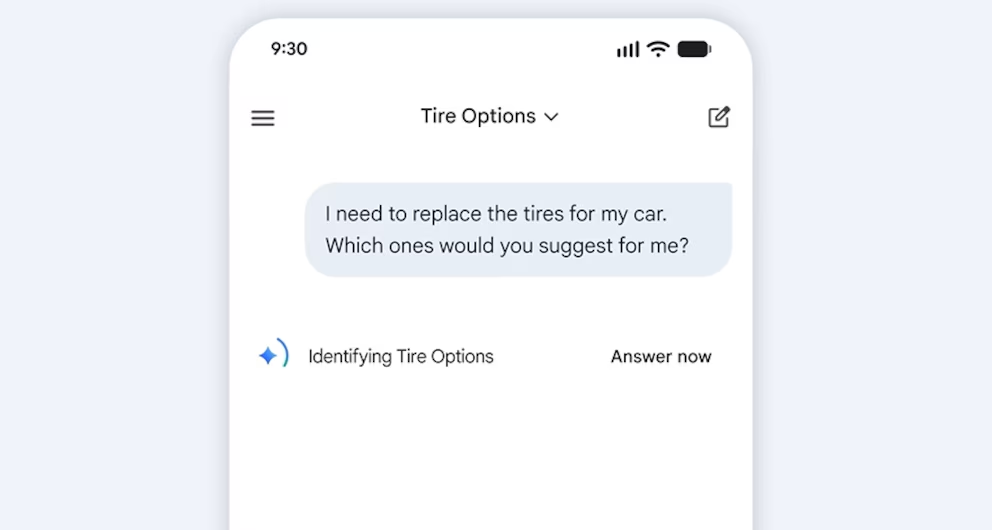
Privacy is central to how personal intelligence is presented. Google states that personal data used by Gemini is processed through encrypted systems and kept separate from public model training. This means your emails and photos are not used to improve general AI models. Users can choose exactly which folders, labels or albums are included. If access is removed, the system is supposed to delete the derived metadata automatically.
This approach has generated debate. Supporters argue that permission based personalization can dramatically improve productivity without sacrificing control. Critics worry that even abstracted data can become sensitive if systems are breached. The design tries to answer this by reducing raw data storage and emphasizing on device or user scoped processing. Still, trust depends not only on design but on long term transparency.
From a practical perspective, early use cases focus on saving time. People spend less effort searching through long email chains, scanning old photos for documents or remembering where something was stored. Instead, they ask questions in natural language and receive summaries or direct answers. This can be especially useful for professionals managing large volumes of communication. But if permissions are poorly managed, the system can surface irrelevant or confusing results.
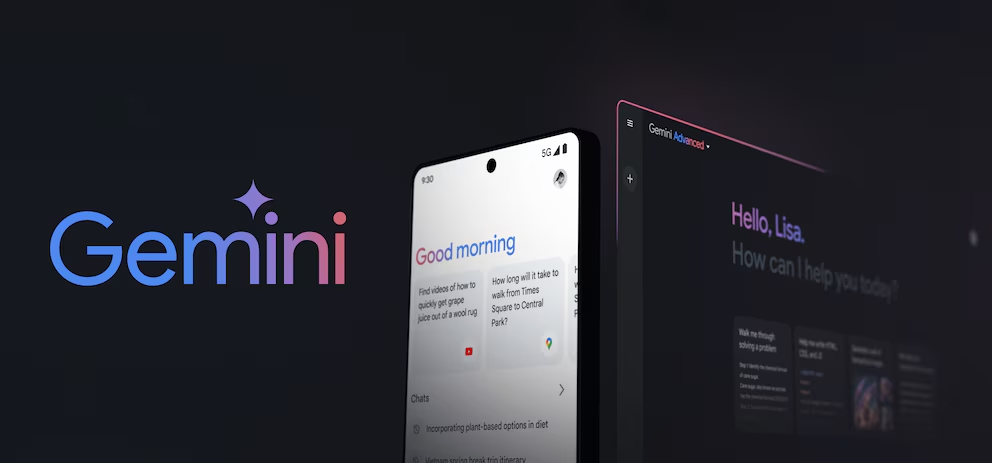
In the long run, personal intelligence represents a shift in how people interact with their own data. Files and messages stop being static objects and become part of a living context that can be queried like memory. The challenge is to ensure that this memory remains under the user’s control. If that balance is achieved, tools like Gemini may change personal computing from search driven to understanding driven.
Truth is structure, not noise. / La verdad es estructura, no ruido.