

 Phoenix 24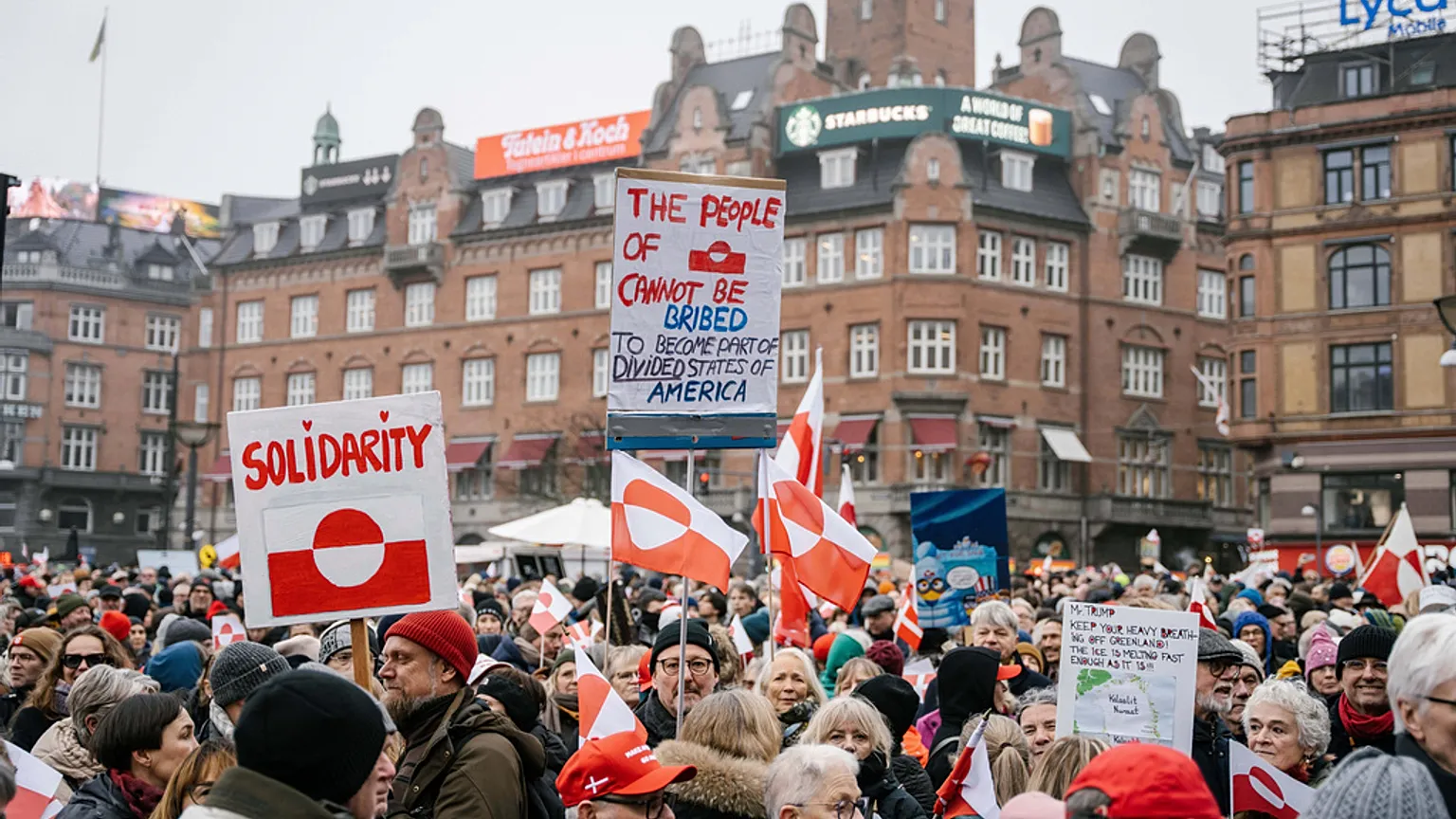
When a territory feels threatened, people leave their homes and take the streets.
Copenhagen, January 2026.
Thousands of people took to the streets this weekend in Denmark and Greenland under a clear and forceful message: Greenland is not for sale. The demonstrations, known as “Hands Off Greenland,” spread across several Danish cities and the Greenlandic capital, Nuuk, as a direct response to recent pressure from the United States government to negotiate control over the Arctic territory.
In Copenhagen, the march moved from central squares toward areas near diplomatic buildings. Families, young people, elders, and civic groups walked together holding signs defending self-determination and rejecting any attempt to turn Greenland into a geopolitical bargaining chip. This was not a small or symbolic rally. It was a visible display of broad social consensus.
Similar gatherings took place in cities such as Aarhus, Odense, and Aalborg. Everywhere, the message was the same: sovereignty is not negotiated under threat. Even organizers were surprised by the size of the crowds, expecting modest protests and instead facing streets filled with determined voices.
At the same time, in Nuuk, Greenland’s capital, thousands of residents filled streets and squares carrying local flags and messages defending their political and cultural identity. For many, the debate over the island’s future is not abstract or diplomatic. It is deeply personal. It is about who they are and who has the right to speak for them.
The protests erupted after U.S. President Donald Trump confirmed the imposition of tariffs against several European countries as indirect pressure to force Denmark to negotiate the sale of Greenland. The strategy, using trade as a political lever, triggered alarm not only among governments but also within civil society.
The Danish government reiterated that Greenland is part of the Kingdom of Denmark with broad self-government and that any decision about its future belongs first and foremost to its own people. Greenlandic authorities were even clearer: there is no intention to negotiate a sale, and they reject the idea that their land can be treated as a strategic commodity.
On the streets, this position took on a more emotional tone. For many protesters, the issue is not only the United States, but the idea that powerful nations still believe smaller territories can be decided from distant offices.
Chants were heard in Danish, Greenlandic, and English, all pointing in the same direction: respect, self-determination, and political dignity. Some signs compared the situation to old colonial practices. Others reminded the world that Greenland is not an empty map, but a living society with language, culture, and memory.
Behind the crisis lies the growing strategic value of the Arctic. Melting ice opens new shipping routes, exposes mineral resources, and reshapes military maps. In that game, Greenland appears as a key piece for surveillance, defense, and control of routes between North America, Europe, and Asia. What Washington calls security, many Greenlanders hear as appropriation.
The protests also sent a message to Europe. Demonstrators demanded that their governments not yield to commercial pressure and not accept that sovereignty be discussed in the language of tariffs. For them, allowing that precedent would mean letting economic force replace law.
Political analysts in Denmark say these marches mark a turning point in public perception of foreign policy. For years, the relationship with the United States was seen as stable. Today, for many citizens, it feels tense, unpredictable, and potentially abusive.
In Greenland, the demonstrations strengthened an identity that has been growing for decades. Although part of the Kingdom of Denmark, the island has a strong autonomy movement. For many local leaders, outside pressure only reinforces the idea that their future must be decided from within, not between global powers.
What happened this weekend was more than protest. It was political education in the street. Ordinary people showing with their bodies what treaties say with words: that peoples are not objects for sale.
While governments argue in diplomatic rooms and powers calculate strategic advantages, in Denmark and Greenland something more basic became clear: when sovereignty is touched, the answer does not always come from ministries, but from people walking together, saying no with their feet and with their voices.
La verdad es estructura, no ruido.
Truth is structure, not noise.