

 Phoenix 24
It was not a fluke, it was a clue hidden in time.
London and Buenos Aires, January 2026.
Scientists studying people who live far beyond a century, often called super old individuals, have uncovered a genetic factor that is reshaping how Alzheimer’s risk is understood in old age. These individuals do not simply live long lives. They often preserve memory, attention and reasoning abilities at ages when most brains show significant decline. By comparing their genetic profiles with those of typical older adults, researchers identified variants that appear to protect the brain from the damage usually associated with Alzheimer’s disease. This finding challenges the idea that aging alone determines cognitive fate and suggests that inherited biological resilience plays a decisive role.
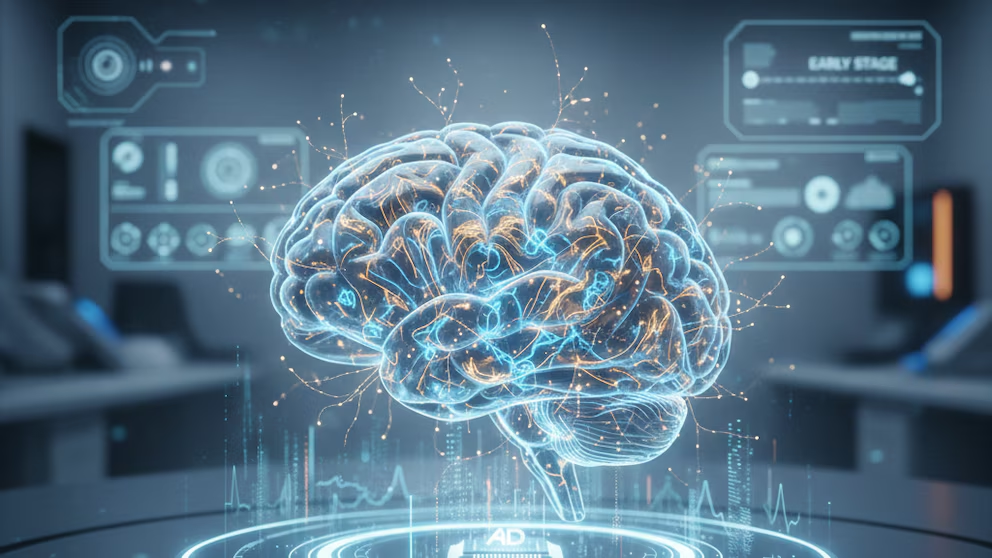
What makes this discovery important is not only the presence of protective genes, but what those genes actually do. Super old individuals show fewer of the biological markers linked to Alzheimer’s, such as toxic protein accumulations and chronic neural inflammation. Their genetic patterns are linked to stronger systems of cellular repair, immune regulation in the brain and resistance to metabolic stress. These traits do not appear in all long lived people, which means longevity and brain protection are not the same thing. Some people live long but lose memory. Others live long and keep it. Genetics seems to explain part of that difference.
This changes how Alzheimer’s risk is framed. For decades, risk models focused on age, lifestyle and well known genetic markers. Now scientists are adding a new category: protective genetic architecture. Instead of only asking who is at risk, researchers are asking who is naturally protected and why. That shift matters because it opens a new strategy. Instead of fighting disease after it appears, medicine could aim to strengthen the same biological defenses that super old individuals already have.

The implications reach far beyond laboratories. If protective genetic signatures can be detected early in life, doctors could identify people who are more vulnerable long before symptoms appear. That would allow prevention strategies to start decades earlier. Nutrition, physical activity, stress management and cognitive stimulation could be adjusted to match each person’s biological profile. The goal would no longer be only to delay decline, but to build resilience from youth.
Yet this discovery also complicates how society thinks about aging. Aging is often described as a slow, inevitable collapse. The super old experience shows that aging can follow very different paths. Some paths involve sharp decline. Others involve stability and clarity deep into old age. Biology does not offer a single script. It offers many, shaped by genes, environment and life history. This challenges public health systems that rely on uniform recommendations for everyone.
Ethical questions follow quickly. If genetic tests can reveal who is protected and who is vulnerable, should everyone know their status. Would that knowledge empower people or burden them with fear. Could insurance companies, employers or governments misuse such information. Genetic insight is powerful, but power without rules can deepen inequality rather than reduce it. Societies will need to decide how to use this knowledge without turning biology into destiny.
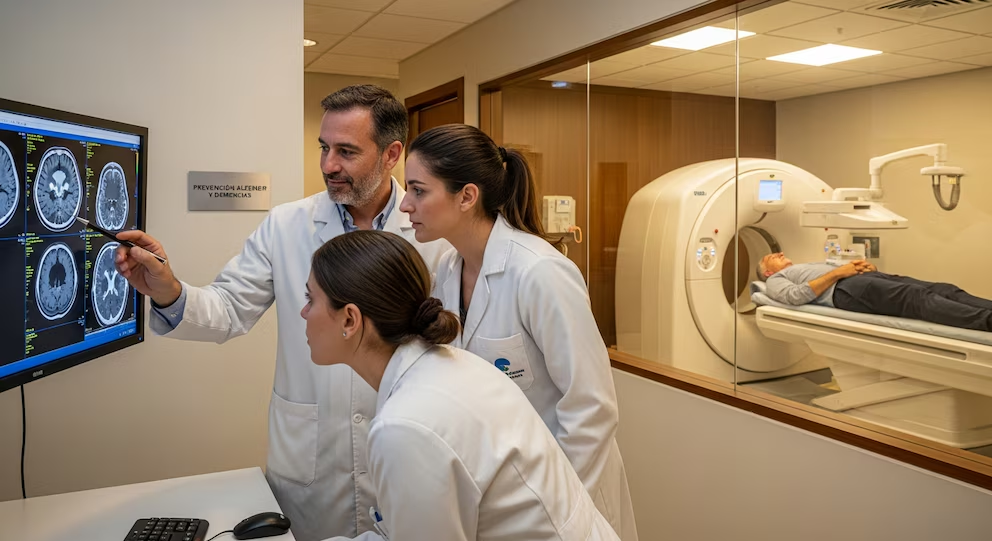
There is also a cultural dimension. Super old individuals change how old age is imagined. They show that memory loss is not a natural law but a possibility among others. That matters for how people treat the elderly and how the elderly see themselves. When decline is seen as inevitable, neglect becomes easier to justify. When resilience is recognized as possible, dignity becomes a reasonable expectation.
This research also opens new paths for drug development. Instead of only targeting the substances that damage the brain, future treatments may try to activate the same repair and defense systems found in super old individuals. That means strengthening neural resilience rather than simply cleaning neural damage. It is a shift from reaction to preparation.
Still, genetics is not destiny. Even people with protective variants can suffer from other age related diseases. And people without them can still live meaningful, cognitively rich lives. Genes shape probability, not certainty. Environment, education, relationships and purpose remain powerful forces in how the brain ages. The discovery of genetic resilience does not cancel the importance of human choice. It reframes it.
What emerges is a more complex vision of aging. Aging is not just decline. It is a field of interaction between biology and biography. Some bodies carry stronger shields. Some do not. But all lives shape how those shields are used.
The story of super old genetics does not promise immortality. It offers something more realistic and more human: the possibility of aging with clarity, memory and identity intact. That possibility, once thought rare and accidental, now appears to have biological roots that science can study and perhaps one day support.
Alzheimer’s disease has long been described as the shadow at the end of life. The study of super old individuals suggests that shadow is not inevitable. It is conditional. And conditions can change.
In that sense, these discoveries are not only medical. They are philosophical. They challenge how society defines old age, decline and value. They suggest that the future of aging is not only longer life, but better life, shaped by understanding what protects the mind as much as what threatens it.
Detrás de cada dato, hay una intención.
Detrás de cada silencio, una estructura.