

 Phoenix 24
When trust collapses inside the space where healing should begin the consequences echo farther than any courtroom.
Los Angeles, December 2025
The first prison sentence connected to the death of Matthew Perry has reshaped a debate that extends well beyond celebrity culture. A former physician, Salvador Plasencia, received a thirty month federal sentence after admitting his role in supplying the ketamine that contributed to the actor’s fatal overdose in 2023. The conviction marks a turning point. It places responsibility not on abstract systems of addiction or on unnamed intermediaries but on a specific figure who violated the ethical boundary that separates treatment from exploitation. In a city where medical innovation and commercial interests often overlap, the case reminds the public that a license to heal carries obligations that cannot be outsourced or ignored.
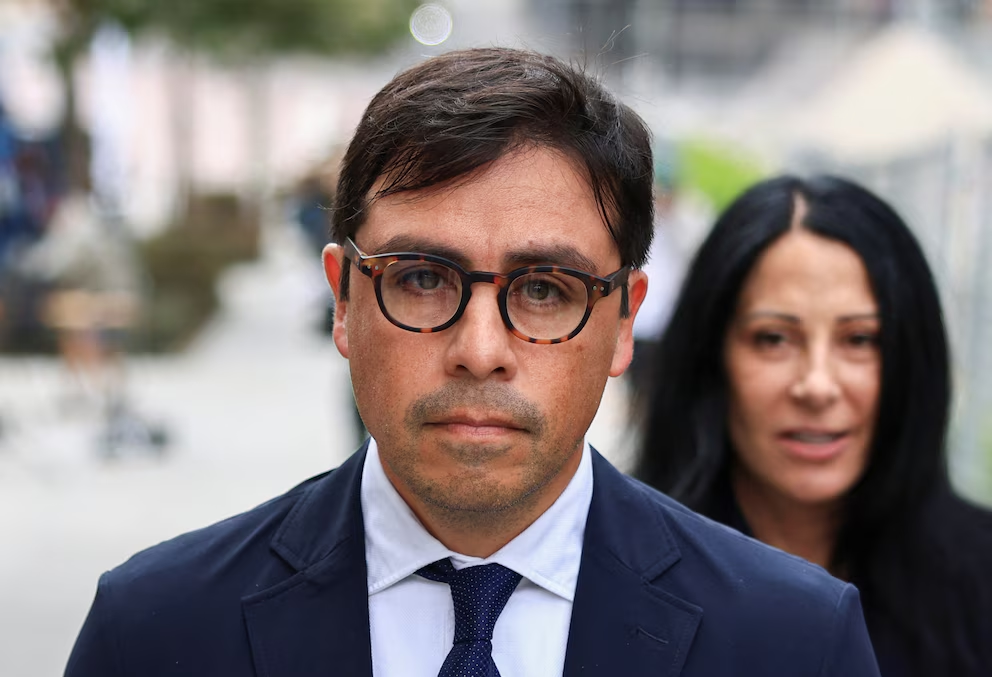
Investigators reconstructed the path that led to Perry’s final hours. They determined that the doctor provided ketamine repeatedly in the weeks before the death despite the actor’s long history of substance dependency. Expert testimony presented during sentencing emphasized that such prescriptions or transfers would have required extreme caution, thorough evaluation and controlled environments. Instead, the drug reached Perry through a chain of informal arrangements that blurred accountability. Specialists in North America who follow prescription drug misuse argue that the case illustrates a pattern repeated across the country. When substances intended for anesthetic or clinical use circulate without proper supervision, the line between therapy and danger becomes perilously thin.
European analysts who monitor medical ethics added another perspective. They noted that ketamine, while recognized for its legitimate psychiatric applications, demands strict procedural safeguards. In many jurisdictions, any deviation from established protocols triggers immediate investigation. From their viewpoint, the California case exposes weaknesses in systems designed to oversee how certain high risk medications are handled. They point to a broader phenomenon. As new therapeutic uses emerge for drugs with recreational or sedative effects, oversight frameworks sometimes lag behind clinical practice, leaving gaps that bad actors can exploit.

Meanwhile, observers in Asia considered the social dimension of the tragedy. They highlighted how celebrity vulnerability often masks deeper structural issues in healthcare cultures that prioritize rapid treatment over long term monitoring. These experts argue that high profile overdoses reveal not only individual struggles but also systemic failures. For them, the sentencing of a medical professional carries symbolic weight because it signals that authorities are willing to confront misconduct within positions traditionally shielded by technical authority or prestige. The case therefore resonates far beyond Los Angeles, entering discussions about regulation, trust and patient safety in multiple countries.
Inside the courtroom, statements from Perry’s family underscored the human cost. They described years spent navigating hope and uncertainty as the actor cycled through periods of recovery and relapse. Their remarks revealed a sense of betrayal. They believed that the people tasked with protecting their son’s well being instead pushed him closer to risk. Legal observers note that victim impact statements in such cases often shape judicial interpretation of intent and negligence. In this sentencing the judge underscored the gravity of breaching medical duty, stating that professional authority magnifies responsibility rather than diminishing it.
The broader investigation into the supply chain that surrounded Perry has already led to multiple guilty pleas. Authorities documented a network of intermediaries whose actions ranged from facilitating access to administering substances without training. Prosecutors portrayed the system not as a single point of failure but as a pattern of coordinated misconduct. Each participant contributed to an environment where oversight dissolved and the actor’s vulnerabilities became opportunities for profit. Public health officials warn that such networks proliferate not only around well known individuals but also among patients with fewer resources, making accountability essential to preventing future harm.

For medical associations in the region the conviction raises uncomfortable but necessary questions. Professional organizations often stress that wrongdoing represents a small minority of practitioners. Nonetheless, they acknowledge that oversight mechanisms must evolve. Continuous evaluation of prescribing patterns, mandatory reporting systems and stronger collaboration between regulatory authorities and clinical institutions form part of the reforms now openly discussed. Ethical scholars argue that preventing tragedies requires more than punishing offenders. It demands building institutional cultures where caution and empathy guide decisions about potentially dangerous treatments.
The sentencing also reverberates within communities concerned with addiction recovery. Counselors and treatment specialists point out that high profile cases risk fostering misconceptions. They emphasize that relapse is a chronic risk, not a moral failure, and that patient safety depends on integrated support networks rather than isolated interventions. They hope the case encourages a deeper look at how fragmented care systems can leave individuals vulnerable even when surrounded by medical professionals. The tragedy, they note, should not obscure the ongoing need for comprehensive mental health policies that address both physical and social determinants of addiction.
As Plasencia prepares to serve his sentence, the public is left with a stark reminder. Authority without accountability becomes a hazard. Medical expertise used irresponsibly can cause more damage than ignorance. The case of Matthew Perry stands as a testimony to the consequences of neglect in environments where trust is not a formality but the foundation of care. The finality of the court’s decision cannot erase the loss, yet it may signal the beginning of a more rigorous approach to oversight and ethical practice in the medical field.
Phoenix24: resistance through narrative. / Phoenix24: resistencia a través de la narrativa.