

 Phoenix 24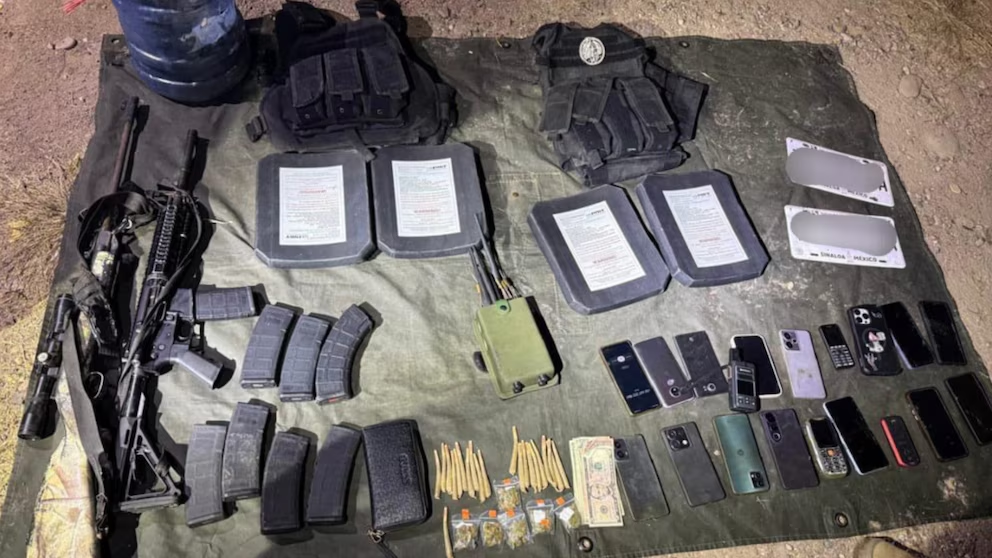
In a city where the line between captivity and survival narrows by the hour, the rescue of twenty people reveals both a tactical success and a structural failure.
Culiacán, November 2025.
The Mexican Army rescued twenty individuals who had been held in captivity inside a clandestine compound in the southern sector of Culiacán, a region that has become emblematic of the evolving architecture of organized violence in northwest Mexico. According to military officials, seventeen men and three women were found restrained inside what appeared to be a covert workshop repurposed for criminal operations. The discovery reinforces long standing concerns from security analysts who describe Sinaloa as a fragmented battlefield where criminal factions diversify into kidnapping, extortion and paramilitary style coercion.
Military units entering the property located tactical gear, rifles, ammunition and communications equipment typically associated with mid level armed cells. Among the items seized were a high calibre long gun, ballistic vests, a signal jamming device and a stolen vehicle. Specialists in national security institutions have repeatedly warned that these types of setups indicate a shift toward more hybrid criminal structures capable of mixing traditional cartel violence with urban concealment techniques. Their analysis aligns with trends observed across Latin America, where organized crime increasingly adopts the operational features of insurgent groups.
Intelligence sources consulted by European research centers emphasize that Sinaloa’s criminal landscape has changed considerably in the last decade. What was once a highly centralized organization under a single command now resembles an ecosystem of semi autonomous groups competing for influence. These internal fractures increase volatility and create the conditions for parallel markets in kidnapping, weapons trafficking and human detention facilities such as the one dismantled by the Mexican Army. Observers in South America draw parallels between this evolution and patterns seen in Brazil’s fragmented criminal networks, where turf wars generate unpredictable surges in violence.
United States security analysts monitoring the region interpret the Culiacán rescue as a symptom of a broader shift in the dynamics of Mexican organized crime. Their reports point out that the proliferation of small cells complicates intelligence gathering and undermines traditional counter cartel strategies that relied on the decapitation of central leadership. Instead, the landscape now requires granular analysis of localized power brokers who operate with fluid alliances and rapid mobility. For Washington based specialists, the incident demonstrates that Mexico’s criminal challenge has transitioned into a scenario requiring approaches closer to counter insurgency than conventional policing.
Inside Mexico, the rescue has triggered cautious reactions from civil society groups who highlight the growing number of enforced disappearances in Sinaloa. Organizations dedicated to locating missing persons argue that the discovery of twenty hostages in one site may represent only a fraction of the broader problem. Their testimonies emphasize that clandestine holding locations are rarely isolated incidents but rather nodes within larger systems of illegal confinement. The operation therefore raises critical questions about how many similar locations remain undiscovered.
Analysts within international organizations such as the United Nations Office on Drugs and Crime frame the rescue as a tactical achievement rather than a structural breakthrough. They warn that without sustained prosecution and dismantling of financial networks, individual rescues will remain temporary victories. Their reports underline that Mexican criminal groups have become increasingly adaptive, capable of relocating operations rapidly and replacing lost personnel with minimal disruption. This adaptability, they caution, complicates any straightforward reading of the Culiacán event as a major defeat for organized crime.
Meanwhile, regional specialists in North Africa and the Middle East view Mexico’s current security crisis as part of a broader pattern of global urban violence in which non state actors exploit weak governance and dense urban environments. Their comparative studies show that operations similar to the Culiacán rescue offer short term relief but do little to reverse long term fragmentation. They argue that Mexico’s challenge resembles situations seen in cities experiencing chronic criminal governance, where states regain single locations but struggle to maintain continuous territorial control.
For local authorities in Culiacán, the rescue serves both as a demonstration of operational capability and as a reminder of persistent institutional limitations. Military officials highlighted the absence of armed confrontation during the operation, suggesting a degree of surprise and precision. Yet the lack of immediate arrests raises doubts about the intelligence chains supporting the rescue. Specialists note that successful operations typically require follow up measures involving financial investigations, digital forensics and coordinated judicial action. Without these layers, the operation risks becoming symbolic rather than transformative.
What remains beyond dispute is that the liberation of twenty hostages reveals both the urgency and the complexity of the security environment in Sinaloa. While the Mexican Army achieved a meaningful tactical result, the deeper structural problem persists: a criminal ecosystem capable of regenerating itself through decentralized networks, diversified revenue streams and strategic concealment. The Culiacán operation may represent a moment of light in a region increasingly shaped by the shadows of impunity, but its lasting impact depends on whether the institutions involved can convert a rescue into a disruption of the system that made such captivity possible.
Phoenix24: facts that do not bend.
Phoenix24: hechos que no se doblan.