

 Phoenix 24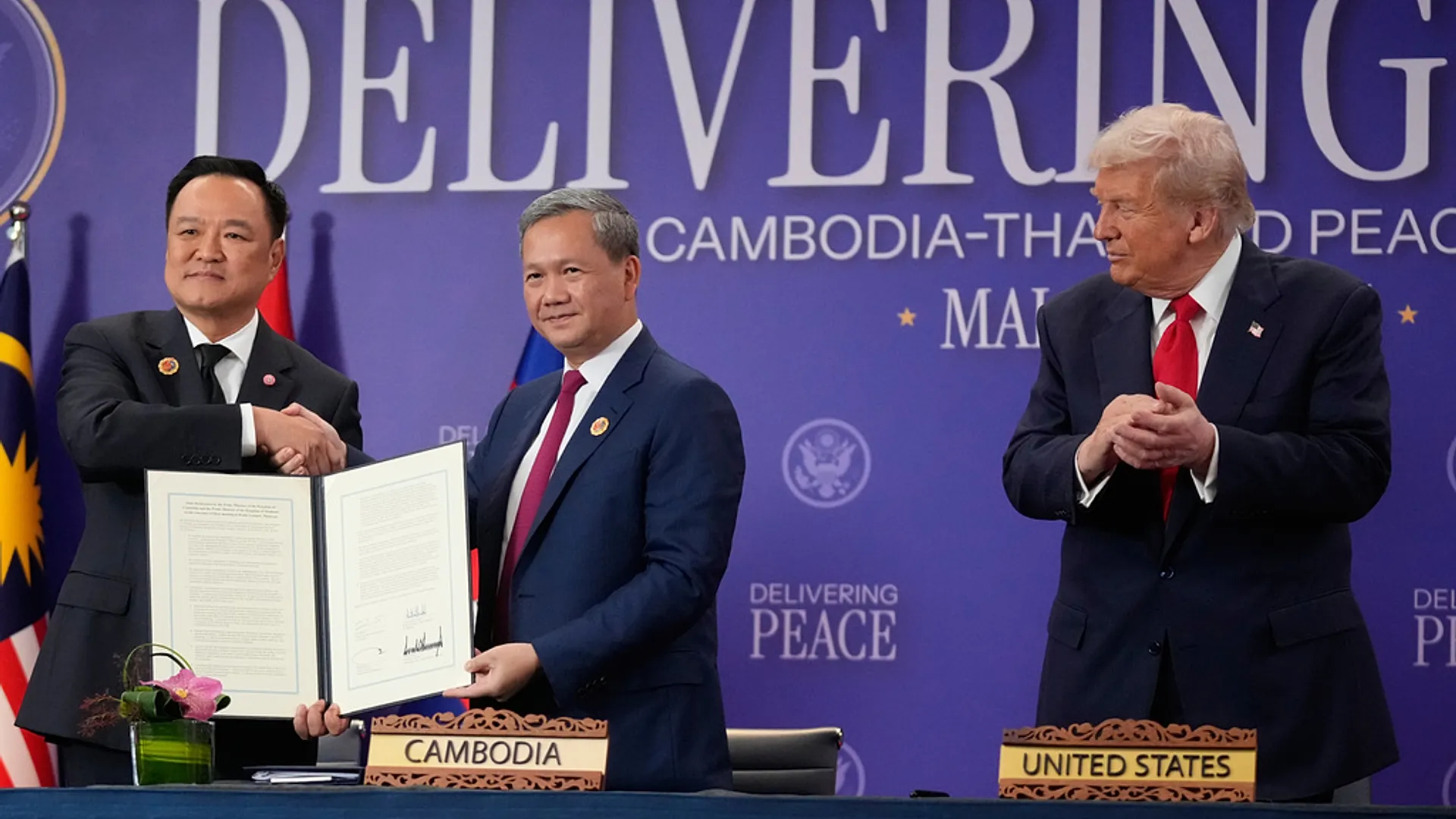
When a handshake crosses forgotten borders, history briefly remembers diplomacy.
Bangkok, October 2025.
In an event that blended political theater with strategic timing, former U.S. president Donald Trump presided over the signing of a peace accord between Thailand and Cambodia — the first formal reconciliation between both nations after more than two decades of territorial and border-related friction. The ceremony, held at the Government House in Bangkok, gathered diplomats from ASEAN, the United Nations, and China, turning a bilateral signature into a regional statement about the return of great-power mediation in Southeast Asia.
The agreement ends a long cycle of skirmishes and mistrust rooted in the disputed Preah Vihear temple region, where intermittent clashes since 2008 had cost dozens of lives and paralyzed border development projects. Negotiations, suspended for years, resumed earlier this year through back-channel diplomacy led by Singapore and the United States. Trump’s surprise appearance as “witness and guarantor” provided the symbolic climax, reviving his self-image as global deal-maker.
For the Thai government, represented by Prime Minister Srettha Thavisin, the accord marks a diplomatic victory. “This is not only peace with our neighbor; it’s peace with our own past,” he declared after signing the document. Cambodia’s premier Hun Manet, son of the country’s long-time leader Hun Sen, emphasized economic cooperation over nostalgia. “Peace has dividends. Our borders should be bridges for trade, not lines for conflict,” he said before an audience of ASEAN envoys.
Behind the ceremonial optimism lies a complex geopolitical web. The peace framework, titled the Bangkok Compact, includes provisions for joint patrols, demilitarized corridors, and shared exploitation of cross-border natural resources. It also invites foreign observation missions under ASEAN oversight — a move that analysts interpret as an effort to reduce Chinese and U.S. competition in the area. The Asian Development Bank is expected to finance infrastructure restoration, while the United Nations Economic and Social Commission for Asia and the Pacific (UNESCAP) will monitor humanitarian reintegration for displaced families.
Washington’s renewed involvement is hardly accidental. According to sources consulted by the Peterson Institute, Trump’s mediation forms part of a wider Republican strategy to re-insert the U.S. as a pragmatic broker in Asia, contrasting with President Biden’s institutional multilateralism. By presiding over an Asian peace accord, Trump reinforces his narrative of personal diplomacy over bureaucratic constraint — and indirectly tests the diplomatic appetite of Beijing, whose foreign ministry cautiously welcomed the outcome.
China’s reaction was measured but revealing. In a communiqué released by the Ministry of Foreign Affairs, Beijing stated it “supports any regional initiative that ensures stability and prosperity” yet reminded both nations that “peace must remain sovereign, not transactional.” For regional observers, the phrase underscores China’s concern that U.S. influence may expand under the guise of mediation. At the same time, Beijing recognizes that the stabilization of the Mekong corridor could favor its own Belt and Road projects connecting Laos, Cambodia, and Thailand.
The United Nations Secretary-General António Guterres hailed the accord as “a constructive model for localized diplomacy in an age of fragmentation.” Within ASEAN, reactions were equally positive. Indonesia’s foreign minister Retno Marsudi suggested that the Bangkok Compact could serve as a blueprint for resolving other latent disputes, particularly those involving maritime boundaries in the South China Sea.
Economically, both Thailand and Cambodia are betting on a post-conflict dividend. The Bank of Thailand estimates that renewed cross-border trade could increase bilateral GDP growth by up to 1.2 percent in 2026. Infrastructure corridors — rail, energy, and logistics — are already under negotiation, with Japanese and South Korean investors eyeing industrial zones near Poipet and Aranyaprathet. The International Monetary Fund, in its regional outlook, described the accord as “a stabilizing signal” that may reduce risk premiums for Southeast Asian markets amid global volatility.
Yet skepticism remains. Human-rights organizations caution that peace on paper may not translate into justice for displaced border communities or demilitarization transparency. The NGO Human Rights Watch noted that several villages remain heavily mined, and that monitoring teams must include civil-society actors to guarantee accountability.
Diplomats familiar with the negotiations describe Trump’s role as both opportunistic and functional. He provided visibility and political leverage, but the substance came from months of ASEAN-led drafting. Still, his presence managed to synchronize opposing agendas for one afternoon — an achievement in a region accustomed to cautious ambiguity.
By sunset, the Bangkok Compact was signed, cameras clicked, and applause echoed across the hall. Yet the more difficult task begins after the handshakes fade: implementing clauses, clearing mines, rebuilding trust. In that fragile choreography between sovereignty and cooperation lies the true test of the agreement.
For Southeast Asia, this peace is not merely the end of a dispute; it is a laboratory of diplomacy under renewed U.S.–China tension. For Trump, it is an act of political resurrection. And for Thailand and Cambodia, it may finally close the border’s longest shadow — one drawn by decades of suspicion and interrupted dialogue.
Phoenix24: analysis that transcends power. / Phoenix24: análisis que trasciende al poder.