

 Phoenix 24
Sometimes passion and precision cross paths far from the court.
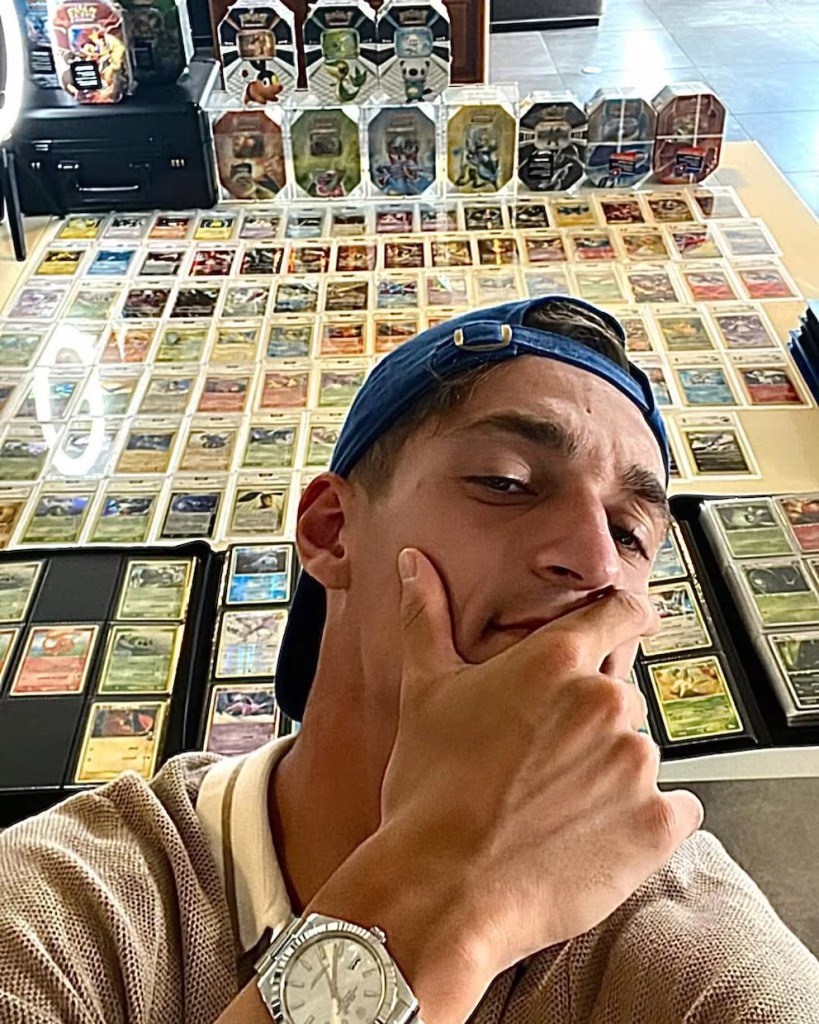
Paris, October 2025. French tennis player Térence Atmane, known for his rising performance on the ATP circuit, has revealed that he owns one of the most extensive Pokémon card collections in France—a treasure so valuable that he decided to secure it inside a bank vault rather than keep it at home. The young athlete, recognized for his explosive left-handed game and quick rise through European tournaments, has become an unlikely symbol of how nostalgia and investment can coexist in the same deck.
In a recent interview with local media, Atmane explained that his fascination with Pokémon began in childhood but evolved into a meticulous pursuit during his years on tour. Between training sessions and tournaments, he tracked down rare cards, including several first-edition holographics that collectors describe as “the crown jewels” of the franchise. Industry experts estimate that the value of his private collection could exceed several hundred thousand euros, depending on grading and rarity.
The tennis player said he now considers the collection part of his long-term financial planning. “I realized that cards can be more stable than some short-term market investments,” he noted, adding that storing them in a vault was a decision motivated by both security and preservation. French financial institutions confirm that high-value collectibles—such as watches, art pieces, and trading cards—are increasingly being placed under bank custody to protect them from theft, humidity, and market volatility.
While Atmane’s passion for collecting is unique among athletes, it reflects a broader phenomenon: the intersection between sports celebrity culture and the investment value of nostalgia. The Bank of France recently reported a steady rise in alternative asset holdings, noting that memorabilia, rare sneakers, and luxury collectibles have become common among younger professionals seeking nontraditional stores of value.
From Tokyo, where Pokémon originated in 1996, the Japan External Trade Organization (JETRO) highlighted the franchise’s continuing economic influence. It estimated that the global market for trading cards and related products surpassed fifteen billion dollars in 2024, with Asia accounting for more than half of global sales. Analysts at the European Central Bank (ECB) added that such passion-driven investment trends illustrate the diversification of asset portfolios in a high-inflation era, where tangible goods often retain purchasing power better than speculative digital instruments.
Atmane’s growing prominence on the tennis scene adds a layer of fascination. Ranked among the top French prospects, he has competed in ATP 250 and Challenger tournaments across Europe, combining athletic discipline with a collector’s eye for detail. Teammates describe him as “methodical and obsessive in both arenas,” a quality that perhaps explains his parallel success on court and in collection management.
Psychologists see in this duality a familiar pattern: the competitive temperament of elite athletes often channels itself into controlled micro-worlds outside sport. The World Health Organization (WHO) has documented how structured hobbies—such as collecting or model building—reduce stress levels and improve emotional regulation among high-performance individuals. In Atmane’s case, the pursuit of rare Pokémon cards appears to provide balance against the mental intensity of global tennis.
In France’s cultural landscape, where art and sport rarely overlap, Atmane’s story has sparked public curiosity. Television programs and magazines dedicated to collectibles have approached him for collaborations, while fan communities discuss which rare cards he might own. Economic commentators, meanwhile, see in his decision a snapshot of generational wealth behavior—where tangible assets rooted in emotion replace the traditional emphasis on property or savings accounts.
The player remains discreet about the exact location of the vault, citing privacy agreements with the bank. Yet he confirmed that part of his collection is periodically appraised and insured, a practice common among high-end collectors. Market analysts suggest that such assets, though unconventional, can outperform traditional investments if properly maintained and authenticated.
For Atmane, the cards represent more than potential gain. “They’re a timeline of my life,” he said, “a reminder of simpler moments that still teach patience and persistence.” As he continues to climb the international tennis rankings, his story stands as a peculiar blend of athletic ambition and sentimental economics—a portrait of how personal passions can evolve into symbols of stability in uncertain times.
The visible and the hidden, in context. / Lo visible y lo oculto, en contexto.