

 Phoenix 24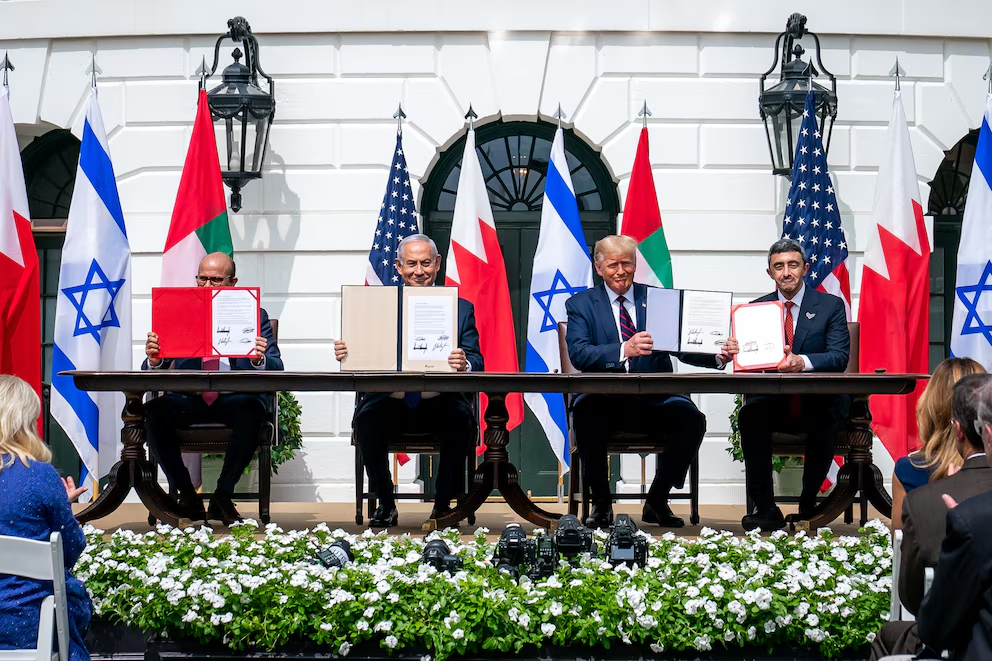
When former enemies begin to speak the same strategic language, peace stops being utopia and becomes architecture.
Tel Aviv, October 2025.
A decade ago, imagining an open alliance between Israel and Sunni Arab nations would have sounded like political fiction. Today, it has become one of the most pragmatic and transformative realities in the Middle East. What began as discreet cooperation on intelligence and defense has evolved into a framework of mutual survival in a region where the real front line is no longer religion, but power, technology, and deterrence.
This emerging axis is built on converging interests more than on historical reconciliation. The threat posed by Iran’s regional projection and its network of proxies has acted as a catalyst, turning former adversaries into partners under a shared logic of containment. From the Gulf to the Mediterranean, security coordination, airspace access, and joint economic initiatives are gradually weaving a strategic fabric that neither ideology nor rhetoric can easily tear apart.
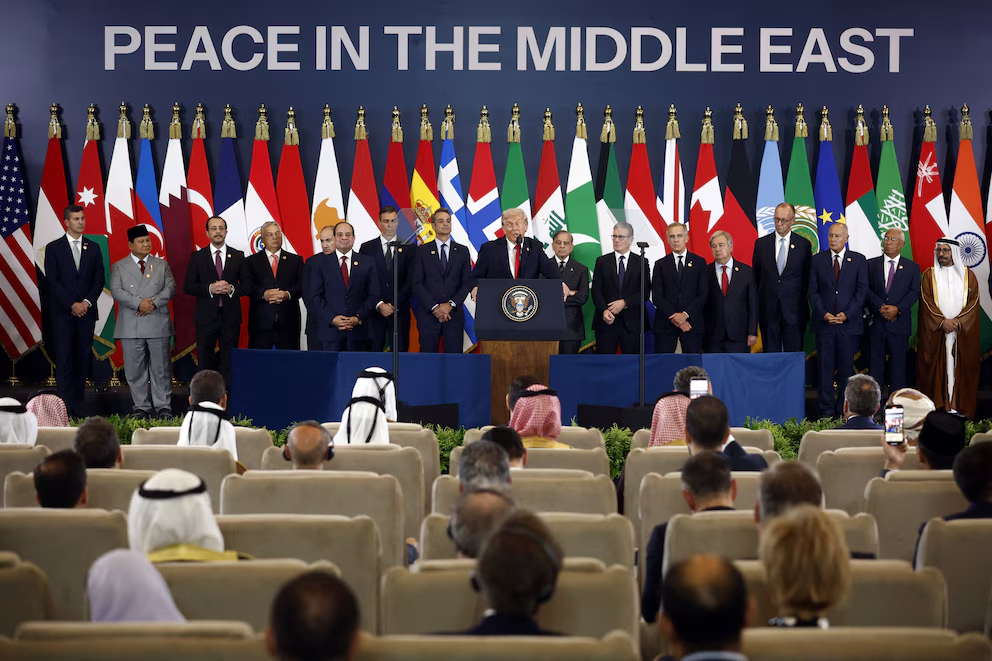
According to analysts from regional institutes in Amman and Tel Aviv, the alliance’s core lies in a new understanding of sovereignty—one that recognizes that state survival in the Middle East depends as much on digital resilience and cyber defense as on conventional deterrence. Israel’s technological edge, paired with Gulf financial capital and logistical reach, has created a hybrid model of cooperation that Western powers can neither ignore nor fully control.
In Riyadh and Abu Dhabi, the shift is not purely defensive. The younger leaderships view normalization with Israel as a gateway to global legitimacy and innovation-driven economies. The Abraham Accords were only the prelude. The new phase is more ambitious: joint ventures in artificial intelligence, maritime security, and renewable energy that could redefine the regional order without Western mediation.
Washington and Brussels watch this transformation with ambivalence. On one hand, it stabilizes a region long dependent on external security guarantees; on the other, it reduces Western leverage in negotiations once dictated by old peace frameworks. The United States remains an indispensable partner, but the locus of initiative has clearly moved eastward, toward local actors capable of aligning interests without intermediaries.
Still, this Semitic rapprochement is not free of contradictions. Palestinian leaders perceive it as an abandonment of their cause, while Shia powers view it as encirclement. Yet the strategic logic behind it seems irreversible. The Arab world’s priority is no longer ideological confrontation but economic survival and technological parity. In that equation, Israel represents a source of capacity rather than conflict.
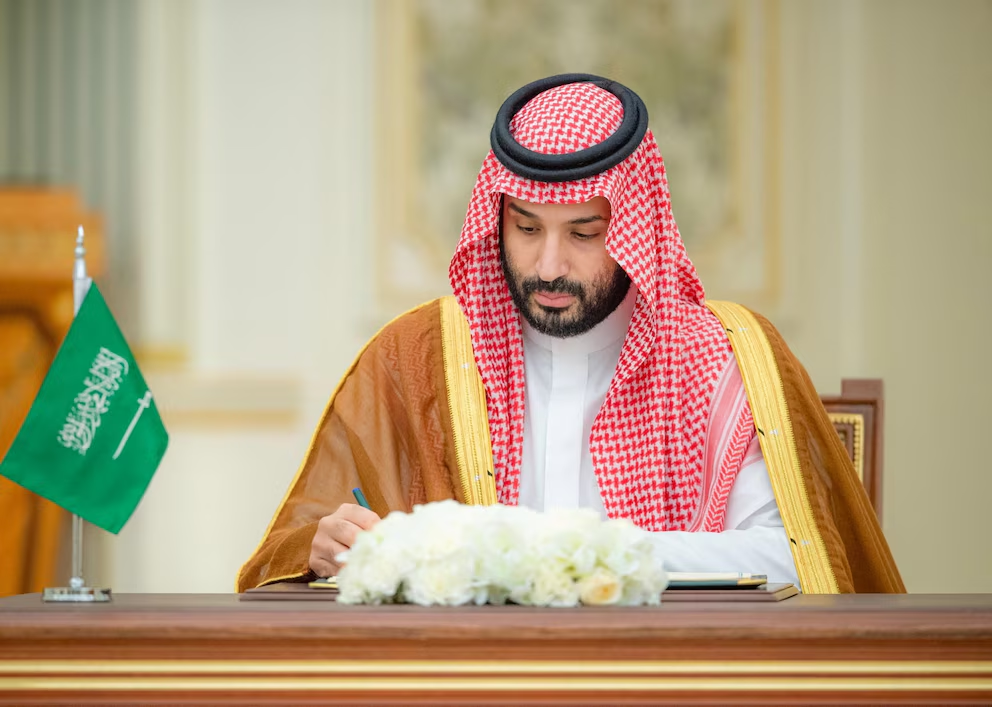
Experts from the International Institute for Strategic Studies describe this evolution as “peace through interoperability.” It is not the peace of moral harmony, but the peace of interdependence—one that acknowledges rivalry yet manages it through shared interests. Trade flows, intelligence exchanges, and even joint drills have created an unprecedented degree of predictability in a historically volatile geography.
The geopolitical implications are profound. If consolidated, this Semitic alliance could neutralize Iran’s ambition to dominate the region, constrain Turkish expansionism, and force global powers to recalibrate their influence. It would also offer a template for other regions fractured by sectarian divides: peace not as reconciliation of memory, but as coordination of survival.
From a historical perspective, what is taking shape may be the most significant realignment in the Middle East since the Camp David Accords. Unlike previous treaties, it is not anchored in idealism or pressure from superpowers but in the pragmatic arithmetic of threats and opportunities. The result is an alliance that does not seek to erase the past, only to make the future tolerable.
For now, the streets of Jerusalem, Dubai, and Manama tell a quiet story: businessmen crossing borders once sealed by dogma, diplomats negotiating under shared digital umbrellas, and intelligence officers comparing vulnerabilities rather than ideologies. Peace, it seems, no longer depends on forgiveness—it depends on design.
Information that anticipates futures. / Información que anticipa futuros.