

 Phoenix 24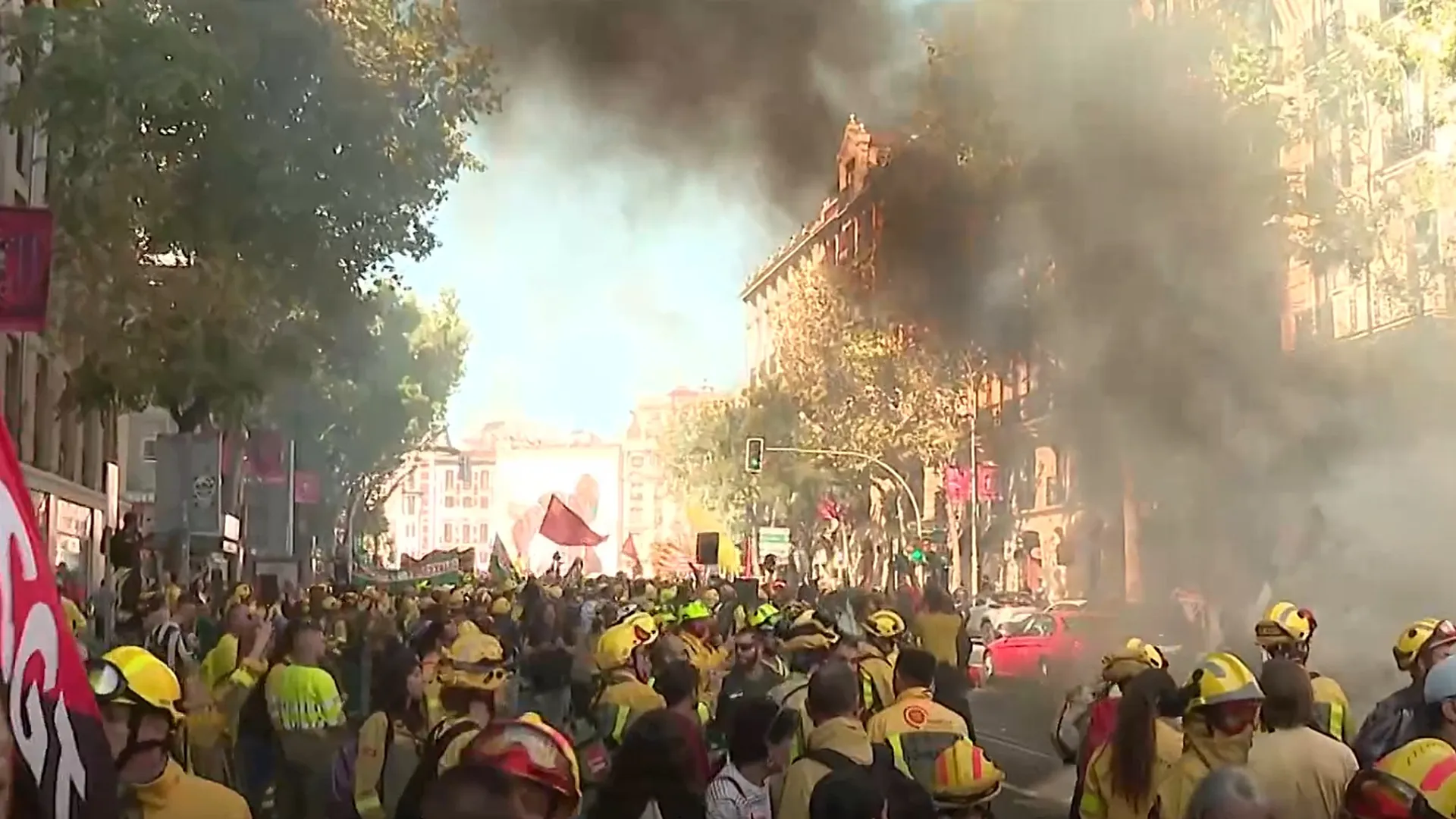
When extreme danger pays less than a tip, the street stops being a stage and becomes evidence.
Madrid, October 2025. The Spanish capital awoke to helmets, banners, and a single, echoing demand: dignity. Thousands of wildfire firefighters and environmental brigades marched through the city demanding that what was promised on paper finally become reality. After another summer of record-breaking fires, they denounced that their labor remains precarious, their contracts seasonal, and their pay barely above the legal minimum—proof that praise and policy rarely meet.
At the center of the dispute lie two recent framework laws intended to standardize the profession and guarantee stability. The texts promised a unified career track, equal pay scales, and continuity of prevention teams. Yet a year later, firefighters say implementation is partial at best. In many regions, supplements for danger barely reach a symbolic euro, while working hours stretch to exhaustion as climate-driven wildfires grow longer and more violent.
The march advanced past government offices and party headquarters carrying one message: civil protection cannot depend on postal codes. Protesters demanded that the new law be applied equally across all regions, with permanent staff, professional training, and year-round operations rather than emergency hiring each summer. They also called for recognition of the mental toll behind each fire—burnout, trauma, and fatigue often ignored in budget discussions.
Across Europe, policy observers followed the demonstration closely. In Brussels, labor-market specialists warned that fragmented regional systems in essential services create inefficiency and risk. Paris and Berlin think-tanks noted that effective prevention depends on funding the “invisible hours”: mapping fuel loads, clearing undergrowth, prescribed burns, and simulation drills. The cost, they argued, is modest compared with the devastation avoided.
From the Americas, workplace-safety organizations compared Spain’s case with North American standards, where collective bargaining ensures risk premiums, mental-health coverage, and mandatory rest cycles. In Australia, the lessons of the Black Summer remain clear: without stable, professional crews and cross-agency coordination, fire seasons become endless loops of exhaustion and loss.
Officials in Spain admit that some progress exists—updated pay tables, improved equipment, partial reclassification of ranks—but the firefighters’ unions see little structural change. “You can’t build prevention on precariousness,” said one representative, summarizing a sentiment shared across the movement. Their argument is both moral and technical: prevention fails when experience walks away after every season.
Beneath the protest lies a clash of public-policy models. One reactive, measuring success by the number of aircraft deployed once the forest is already burning. The other preventive, investing early in stable brigades, science-based forest management, and dignified jobs that retain expertise. The firefighters’ march defends the latter, calling for less emergency heroism and more long-term structure. Studies cited by European institutes show that every euro invested in prevention saves several when flames reach the valleys and smoke darkens the sky.
Madrid served as an amplifier, but the demand is national. The associations leading the protest vow to maintain pressure until the new laws are fully applied. “We don’t want applause at the end of the season,” said a veteran crew leader. “We want contracts that last longer than the applause.” Their list of demands could fill volumes—fair pay, full staffing, permanent teams, continuous training—but all converge on a simple truth: without consolidated brigades, there are no safe forests and no secure towns.
Some observers frame the mobilization as a labor dispute; others as an overdue reckoning after decades of patchwork policy. For the firefighters themselves, it is something deeper: the right to protect without being forgotten. Spain must now decide whether its defense against fire will rest on exhausted heroes or on resilient institutions. The difference is invisible when the forest burns—but unmistakable when it does not.
Against propaganda, memory. / Contra la propaganda, memoria.