

 Phoenix 24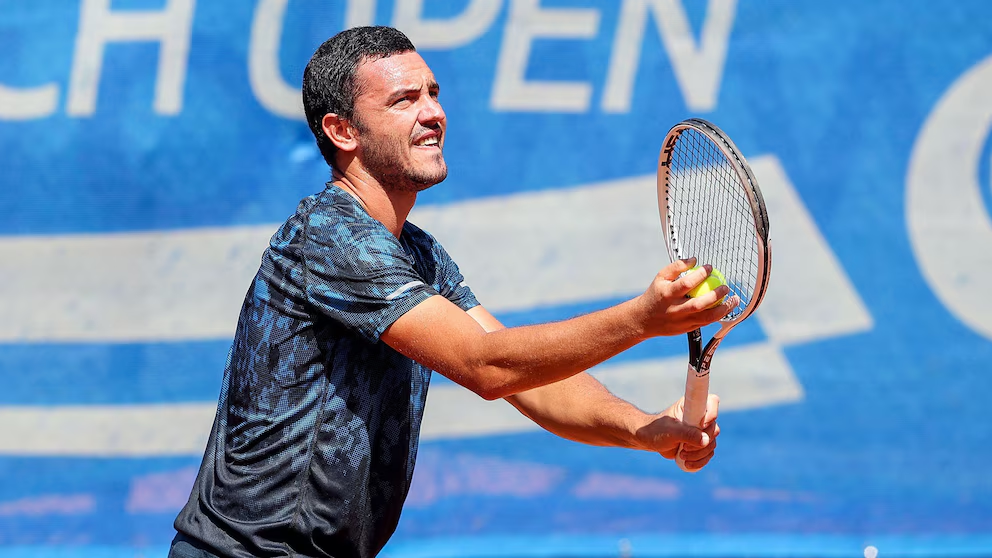
The explanation sounded almost cinematic: a kiss, an accusation, and a banned substance. But the tribunal was not convinced.
London, October 2025. Portuguese-born Venezuelan tennis player Gonçalo Oliveira has been suspended for four years after testing positive for methamphetamine during the Manzanillo Challenger tournament held in Mexico in late 2024. The International Tennis Integrity Agency confirmed that both his A and B samples contained the stimulant, which is classified as a prohibited substance under the Tennis Anti-Doping Programme.
Oliveira’s defence claimed the contamination occurred through a kiss with a woman who, according to him, had consumed a recreational drug at a party prior to their encounter. The argument failed to convince the independent tribunal, which described the story as “scientifically implausible.” Laboratory experts testified that the concentration found in the athlete’s system was far too high to be attributed to passive transfer.
The disciplinary panel concluded that the violation was intentional, citing the absence of any medical prescription or therapeutic exemption. Oliveira’s suspension will remain in effect until January 2029, and he will forfeit all ranking points and prize money earned since the date of the test. His name will also appear in the official register of anti-doping sanctions maintained by the sport’s governing bodies.
The ruling has revived debate over the credibility of doping defences and the burden of proof placed on athletes. Anti-doping authorities note that unsubstantiated claims of contamination have increased in recent years, often invoking accidental ingestion or contact. According to sports law analysts in Europe, such arguments rarely succeed unless supported by verifiable scientific data.
In Latin America, Oliveira’s case drew mixed reactions. Some commentators viewed the sanction as excessively harsh for an athlete ranked outside the top 200, while others argued that leniency would undermine fairness in a sport striving to rebuild credibility after repeated scandals. Venezuelan sports federations issued no official statement, reflecting the sensitive nature of national representation amid political and institutional tensions.
From the United States, the U.S. Anti-Doping Agency emphasised that accountability remains central to sporting integrity. Its director reiterated that every athlete is responsible for what enters their body, regardless of how improbable their explanation might seem. Asian sports correspondents highlighted that similar defences have surfaced in China and Japan, though none have met the rigorous evidentiary standards required to overturn a ban.
The case also echoes a well-known precedent from 2009 involving French player Richard Gasquet, who successfully argued that cocaine traces in his system resulted from kissing a woman at a nightclub. Experts point out, however, that Gasquet’s levels were thousands of times lower than those found in Oliveira’s test and that the context was significantly different.
In Oliveira’s situation, the tribunal stressed that the principle of strict liability applies to all competitors, regardless of rank or intent. As a result, he becomes another cautionary example in a global system that continues to test the thin boundary between innocence and responsibility.
For professional athletes, the message is unambiguous: improbable excuses carry real consequences, and science does not bend to sentiment.
Phoenix24: analysis that transcends power. / Phoenix24: análisis que trasciende al poder.