

 Phoenix 24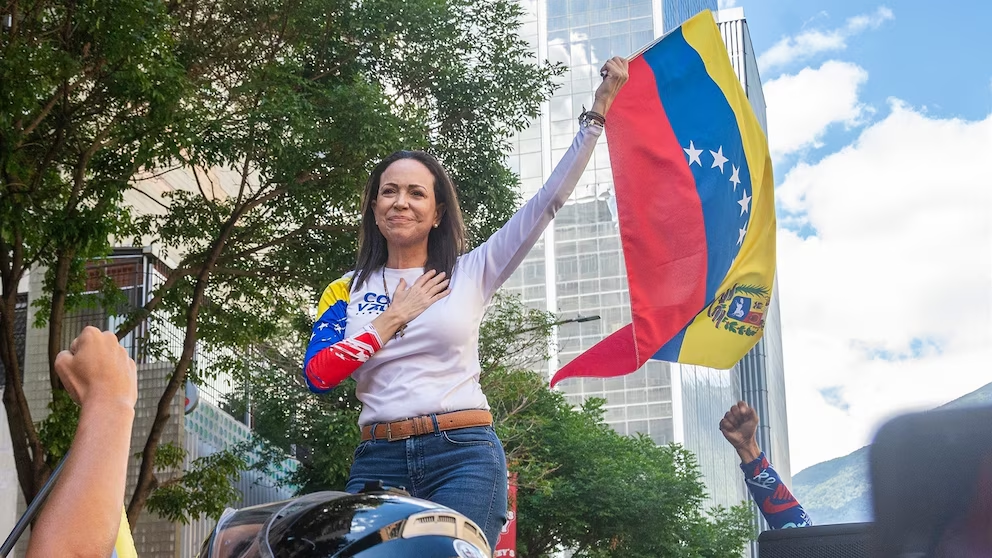
Her transformation from persecuted opposition figure to global symbol of resistance has altered Venezuela’s political landscape and unsettled the world’s perception of authoritarian endurance.
Caracas, October 2025. When the Norwegian Nobel Committee announced that María Corina Machado had been awarded the 2025 Peace Prize, Venezuela stood still for a moment that few believed possible. Once banned from running for office and accused of treason by the Maduro government, she became the first Venezuelan ever to receive the world’s most prestigious recognition for peace and democratic struggle. The committee’s statement praised her “tireless advocacy for human rights and her nonviolent commitment to restoring democracy in Venezuela,” a phrase that immediately reverberated through Latin America.
For over two decades, Machado has been one of the most visible and uncompromising voices against Nicolás Maduro’s regime. Her activism began in the early 2000s, when she co-founded the citizen-monitoring organization Súmate, which challenged the opacity of Venezuela’s electoral processes and provided a platform for civic accountability. Elected to the National Assembly in 2010, she was expelled just four years later after denouncing government abuses before the Organization of American States. Since then, she has lived under constant threat, enduring raids, harassment, and multiple disqualifications from public life.
The 2024 presidential race became a turning point. Machado won the opposition primaries by an overwhelming margin, only to be barred from the ballot by electoral authorities aligned with the regime. Forced into semi-clandestinity, she continued coordinating resistance networks and international lobbying from within Venezuela, defying restrictions that sought to erase her from the political scene. The Nobel Committee’s recognition now turns that defiance into an emblem of legitimacy.
International reactions arrived swiftly. In Washington, the State Department called the award “a tribute to the courage of Venezuelan citizens who continue to demand democracy.” In Brussels, European diplomats described the decision as a symbolic blow to authoritarianism and a reminder that peaceful opposition remains possible even under repression. From Tokyo, editorialists at Nikkei Asia highlighted how Machado’s recognition repositions Latin America within the global narrative of democratic renewal, placing Venezuela at the center of a conversation about moral resilience in the Global South.
Inside Venezuela, reactions were divided. Supporters celebrated in plazas, waving national flags and chanting “freedom has a name.” Government officials dismissed the prize as “foreign interference,” accusing Western powers of manipulating international institutions. Yet even among regime insiders, the tone was notably defensive. Analysts from the Universidad Central de Venezuela observed that the award undermines years of propaganda portraying the opposition as irrelevant.
The Nobel Peace Prize has rarely carried such clear political weight in recent Latin American history. Scholars at the University of Oxford pointed out parallels with Lech Wałęsa’s and Aung San Suu Kyi’s recognitions decades earlier, though they warned that prizes cannot substitute for political transformation. What they can do, however, is shift global attention —and money— toward the humanitarian crisis that has pushed more than seven million Venezuelans into exile.
For Machado, the moment was both personal and collective. “This prize belongs to every Venezuelan who refused to surrender,” she said in a message broadcast from Caracas, her voice breaking with emotion. “It proves that courage and truth still matter.” Her words, simple yet defiant, resonated far beyond national borders.
The recognition also challenges the regional status quo. In Bogotá and Buenos Aires, leaders of neighboring democracies congratulated Machado, seeing in her victory a moral warning to populist experiments that blur the line between power and legitimacy. In Beijing and Moscow, state media downplayed the award, describing it as “politically motivated.” The contrast revealed how one woman’s name can expose the fractures of an entire geopolitical order.
Whether the Nobel Prize can translate into tangible change remains uncertain. The Venezuelan regime retains full control of the judiciary, the military, and the media. But the international visibility now surrounding Machado limits the government’s ability to act with impunity. As one diplomat in Geneva noted, “She is no longer just an opponent; she has become an institution.”
In a nation accustomed to despair, the sound of applause from Oslo became a rare form of hope. For many Venezuelans, it felt like the world had finally listened.
Phoenix24: beyond the news, the pattern. / Phoenix24: más allá de la noticia, el patrón.