

 Phoenix 24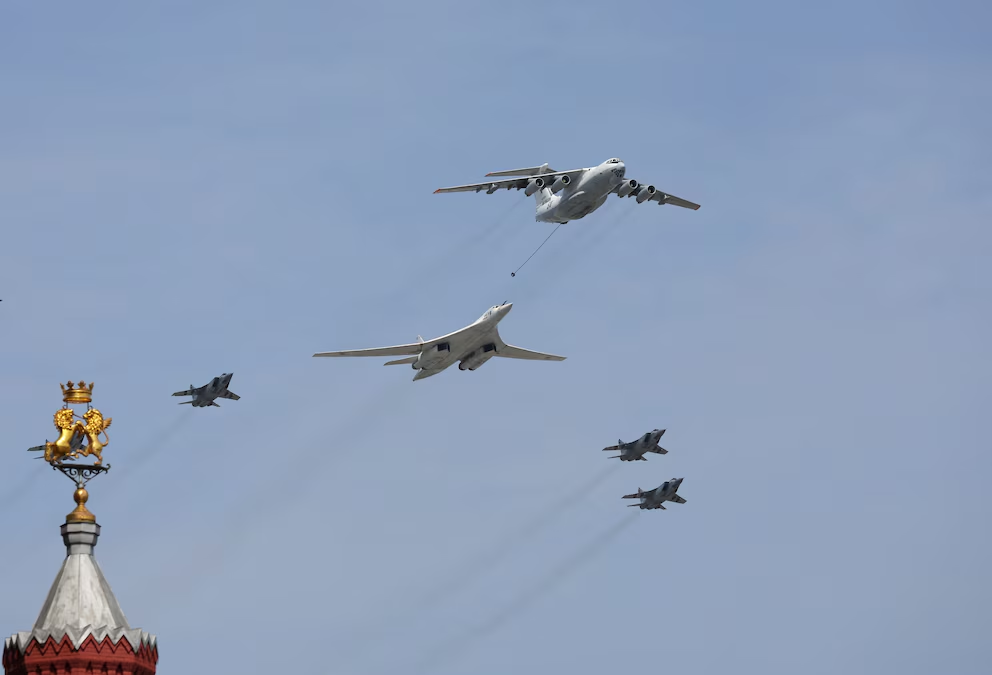
What once were isolated incidents are now a systematic campaign — and Europe is running out of patience.
Brussels, September 2025. A quiet but dangerous escalation is unfolding above Europe’s skies. Over the past months, Russian military aircraft have repeatedly breached the sovereign airspace of NATO and EU member states with near-total impunity, testing the boundaries of international law and Western deterrence. What might seem like mere provocations are, according to defense analysts, part of a deliberate strategy to erode Europe’s air defense posture, probe response times, and normalize aggressive behavior just below the threshold of open conflict.
According to NATO Air Command, intercept missions involving Russian aircraft have surged by more than 40% this year, with incidents recorded over the Baltic Sea, the North Sea, and even the Arctic approaches to Norway and Finland. While Moscow insists these flights are “routine training exercises,” the aircraft involved — often strategic bombers or intelligence-gathering platforms — follow flight paths deliberately close to civilian air corridors and critical infrastructure, raising the risk of miscalculation or accidental escalation.
European governments have responded with diplomatic protests and increased patrols, but the pattern shows little sign of abating. Defense experts at the Royal United Services Institute (RUSI) argue that these incursions are not isolated provocations but components of a broader coercive strategy. “The Kremlin is signaling that it can project power anywhere and at any time,” notes one analyst, “while simultaneously testing the cohesion of NATO’s air defense network.”
The incursions have not been confined to the alliance’s eastern flank. In recent weeks, Russian aircraft were intercepted near the coast of Ireland and over the North Sea, prompting emergency responses from British, Dutch, and Belgian fighter jets. France reported a similar incident off Brittany, while Sweden confirmed that two Russian Su-27 fighters entered its airspace over Gotland before being escorted out by Gripen jets.
For Moscow, these actions serve multiple purposes. They allow Russia’s air force to collect valuable intelligence on radar coverage and interception protocols, while also creating political pressure on European governments. As the European Council on Foreign Relations (ECFR) points out, each incident forces national leaders to balance military responses with diplomatic caution, often revealing differences in threat perception among allies.
The psychological dimension is equally significant. By normalizing airspace violations, Russia seeks to create a “new normal” in which its aggressive behavior is tolerated as routine. This technique, often referred to by security scholars as “strategic friction,” mirrors tactics previously used in cyberspace and maritime domains — slow, persistent provocations that blur the line between peace and conflict.
Meanwhile, the implications for civilian aviation are deeply concerning. Eurocontrol, the EU’s air navigation safety organization, has warned that Russian aircraft frequently switch off transponders during these flights, making them invisible to civilian radar systems and posing a potential collision risk. Commercial airlines have reported multiple “near-miss” incidents, particularly in busy corridors over the Baltic region.
The United States has also taken note. Officials from the Pentagon and the U.S. European Command have urged European allies to strengthen integrated air defense coordination, particularly in the high north and around the Suwałki Gap — the narrow corridor linking Poland and Lithuania that is considered one of NATO’s most vulnerable points. Washington has increased its aerial patrol presence in the region, deploying additional F-35 fighters to bases in Germany and the United Kingdom.
Russia’s motivations are complex but interconnected. According to analysis by the Center for Strategic and International Studies (CSIS), the escalation coincides with Moscow’s deteriorating strategic position in Ukraine and its deepening partnership with Beijing. The Kremlin appears intent on demonstrating that, despite sanctions and battlefield setbacks, it retains the capacity to challenge Western power across multiple domains.
Yet Europe’s response remains uneven. While frontline states such as Poland and Finland advocate for a more assertive deterrence posture, others, including Germany and Italy, emphasize the need to avoid escalation. This divergence risks undermining NATO’s credibility, a vulnerability the Kremlin is eager to exploit.
Some officials believe the incursions are also designed to send a message to countries like Sweden and Finland, whose accession to NATO represents a significant strategic setback for Russia. By operating aggressively near their borders, Moscow signals that their security will not be guaranteed merely by joining the alliance — an attempt to sow doubt and hesitation among new members and potential partners alike.
The stakes are rising. With every unchallenged violation, Russia pushes the boundaries of acceptable behavior a little further, recalibrating the balance of power in Europe’s skies. The question now is whether the alliance will adapt quickly enough to deter future incursions — or whether these repeated provocations will become the prelude to something far more dangerous.
Phoenix24: intelligence for free audiences. / Phoenix24: inteligencia para audiencias libres.