

 Samira El-Khalil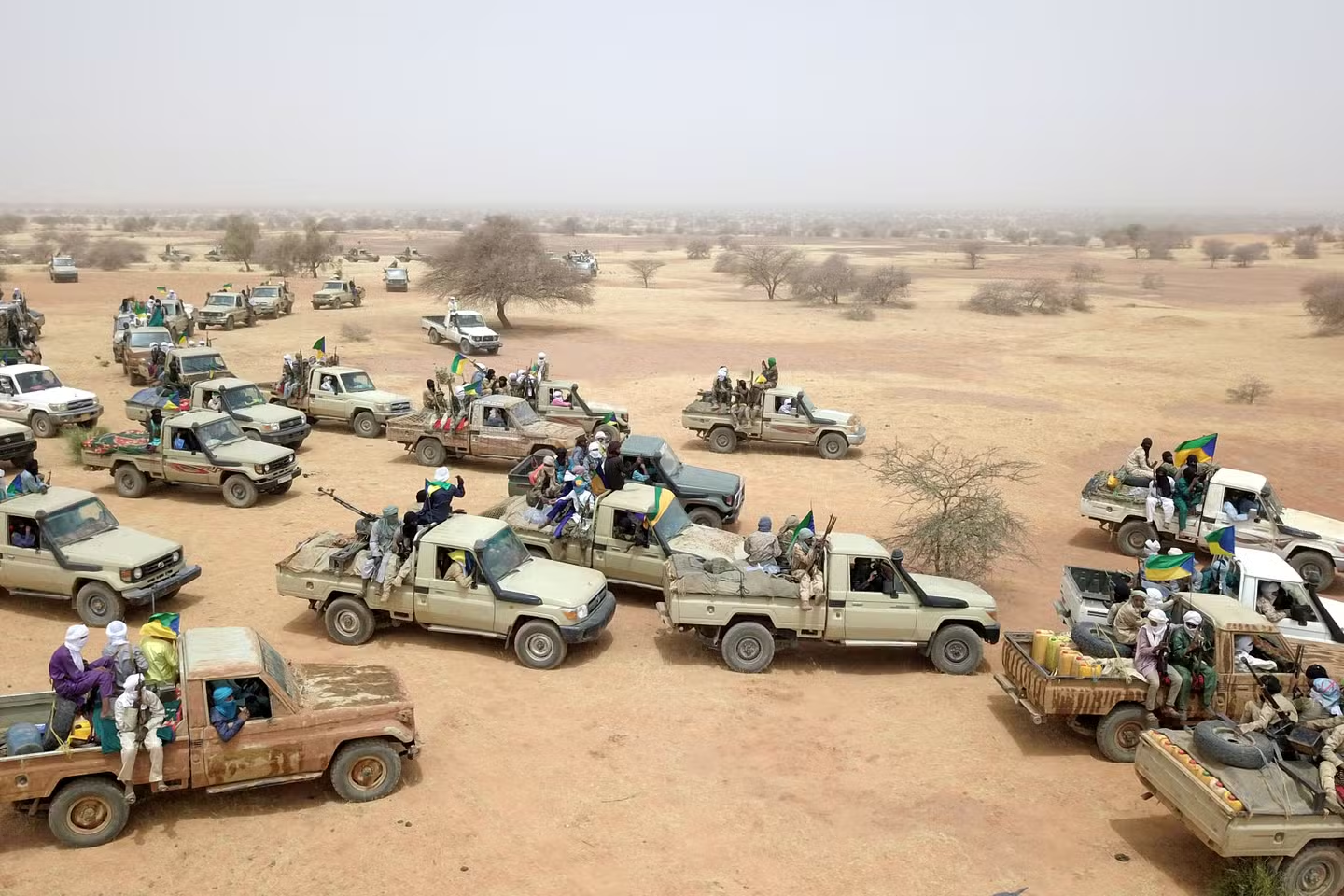
In the Sahel, war no longer needs flags to occupy territory, nor uniforms to impose obedience.
Bamako, August 2025 — I have walked through villages that do not appear on official maps, where dust covers the houses and rumors cover the truth. Here, in the heart of the Sahel, war does not announce itself with parades or communiqués; it seeps in like a shadow, disguised as a mining contract, a security convoy, or a “stabilization” mission.
After the withdrawal of most Western forces, what remained was not peace. The vacuum was filled by mercenary networks, some with a visible past under the Wagner name, now fragmented into companies operating out of Dubai, Istanbul, or Bangui. Their real flag is exclusive access to deposits of gold, uranium, and lithium. The official narrative speaks of “cooperation” and “investment protection,” but on the ground, what is felt is the logic of covert occupation.
I have seen security contracts that quietly hand over control of mines for decades. I have seen local soldiers—equipped with rifles imported from Moscow or Beijing—guarding routes that carry critical minerals to ports that do not even belong to the country extracting them. And I have seen how, while the wealth moves outward, nearby communities are displaced, their water contaminated, and their voices silenced.
The other front of this war is fought in the digital space. Anonymous accounts on Facebook and TikTok spread manipulated videos portraying private militias as forces of order, while branding activists and journalists as “enemies of the state” or “foreign agents.” This is no coincidence: discrediting the critical voice is as strategic as guarding a lithium well.
Lithium is now the Sahel’s new oil. Its control determines not only the world’s energy future but also who will dictate the rules of this region for decades to come. China, with its strategic patience, has secured access to key deposits in exchange for infrastructure. The European Union, wrapped in its “green transition” narrative, signs agreements that replicate, under another name, the extractive logic of colonialism.
It does not surprise me that in Bamako, Niamey, or Ouagadougou, officials speak of “reinforced sovereignty” while critical decisions are negotiated in far-away capitals. What does surprise—and worry—me is how quickly this model is becoming normalized: a hybrid of armed occupation and narrative control that needs no open invasion to shape a country’s destiny.
The Sahel is now a laboratory. Here, intervention formulas are tested that combine boots on the ground with bots on the networks; contractual clauses with psychological operations; promises of security with accelerated resource extraction. And I fear that what is perfected here will be exported to other strategic regions long before the international community dares to call it by its name: a war that wears no uniform, yet leaves visible scars on bodies, lands, and collective memories.
Samira El-Khalil, North Africa & Sahel correspondent at Phoenix24, exposes how militias, foreign mercenary networks, and digital propaganda converge to reshape fragile states—blending historical memory with on-the-ground insight to decode the hidden architecture of power in post-colonial Africa.