

 Callum Hayes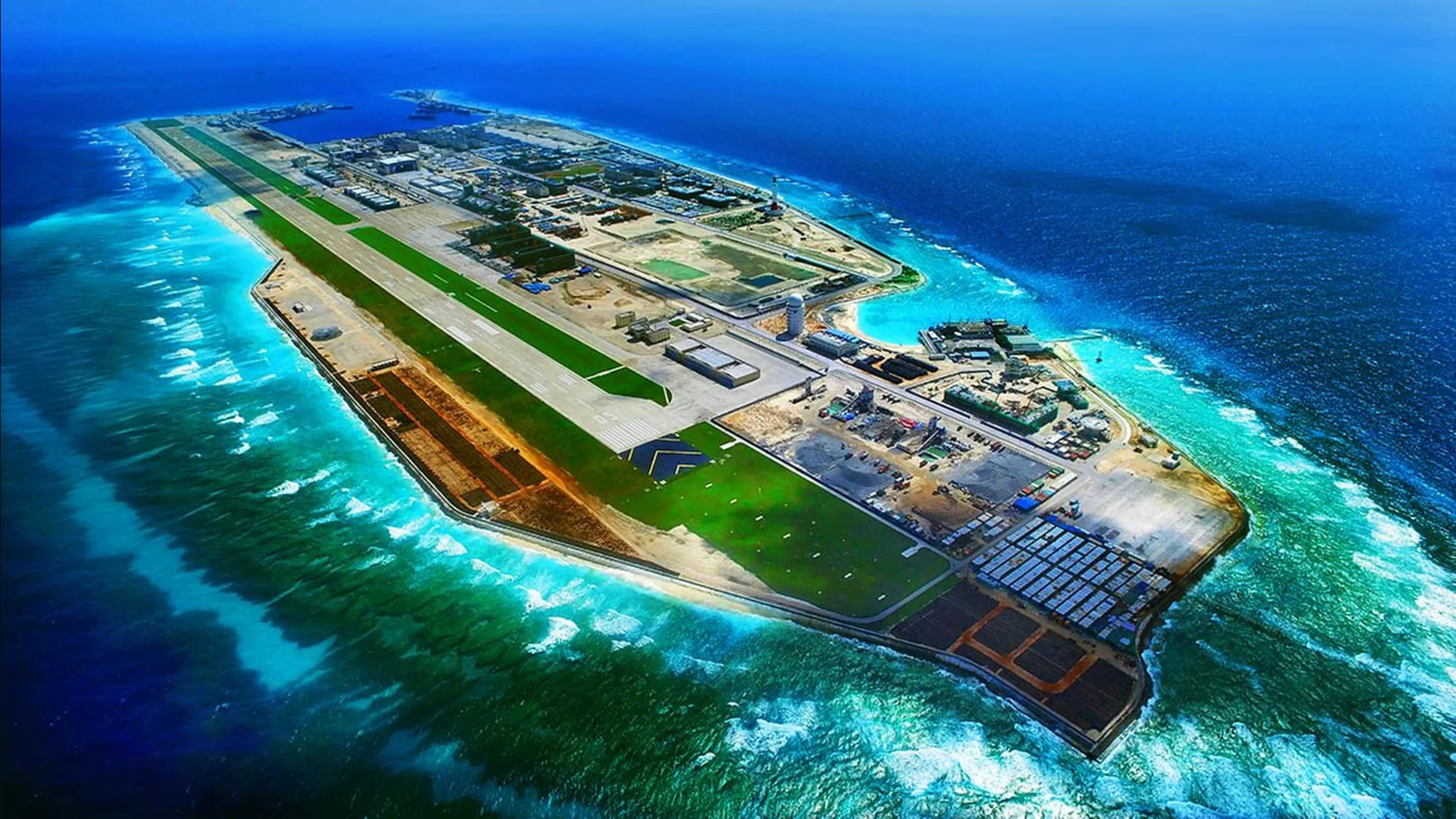
There are no sirens in the South China Sea. No midnight detonations, no convoys of refugees fleeing through the jungle. And yet, this remains one of the most heavily contested and militarized maritime zones on the planet: a silent archipelago, meticulously constructed to conceal a war that refuses to name itself.
I’ve stood on fishing piers in Palawan, where captains whisper of ghost ships trailing them for days. I’ve studied satellite images showing airstrips blooming like tumors atop once-pristine reefs. And I’ve attended intelligence briefings where the language has shifted—no longer centered on missiles, but on intentions. Here, power is not imposed through destruction, but through presence. This is a conflict waged in silence—strategic, psychological, and deliberate.
Militarization Without Confrontation
The true danger in the South China Sea is not conventional warfare but the slow suffocation of sovereignty. China’s so-called “Nine-Dash Line” cuts through the exclusive economic zones of Vietnam, the Philippines, Malaysia, and Brunei. Its legitimacy has been rejected by international courts, yet its enforcement occurs without formal troops—carried out instead by maritime militias, coast guard flotillas, and infrastructural creep.
The world refers to these vessels as “fishing boats,” but many are equipped with radar systems, signal jammers, and in some cases, armed personnel. They do not fire because they do not need to. Their mission is psychological: to intimidate, exhaust, and normalize their presence. This is occupation by habituation—hegemony through repetition.
The Strategy of Narrative Erosion
From my years covering hybrid operations and maritime tensions across the Indo-Pacific, I have come to recognize a carefully orchestrated narrative manipulation strategy: deny the incursion, accuse the accuser, and flood the information space with noise and ambiguity. This is a well-documented pattern in low-intensity conflict: weakening truth through informational attrition.
Meanwhile, ASEAN remains silent. Internal fragmentation, economic dependency, and a pervasive fear of retaliation have produced what I call manufactured acquiescence. No member state wishes to be the first to speak out, and so all wait—each hoping someone else will.
And in that silence, the status quo deepens.
Reporting From the Edges of the Map
In the coastal communities I’ve visited—from Kudat in Malaysia to the outermost points of Luzon—fear is not expressed in outcry. It is visible in smaller details: fishermen no longer venturing far offshore, communication equipment inexplicably failing, and conversations beginning with, “I shouldn’t be telling you this, but…”
One elderly fisherman, whose village lost access to its traditional fishing grounds now guarded by Chinese vessels, said something I’ve never forgotten:
“When we were young, the sea was a map of freedom. Now, it’s a wall.”
That line stays with me because this is not merely a contest over territory—it is a contest over perception. When people begin to internalize the idea that certain waters no longer belong to them—despite maps, laws, and international rulings—that is when the battle is truly lost.
The Digital Maritime Front
While vessels patrol the waters, another form of control is expanding: the digital maritime domain. China is integrating satellite surveillance powered by AI, undersea drones, and quantum communications into a comprehensive geostrategic architecture. It no longer needs to deploy conventional forces—data suffices.
Australia, Japan, and the United States have responded with joint naval exercises, cyber defense collaborations, and frameworks like AUKUS. But they are reacting to a playbook that Beijing has been refining for over a decade. Every day the international community avoids naming this hybrid occupation for what it is, its de facto legitimacy grows.
Silence as a Weapon
The South China Sea is no longer just a body of water. It has become the epicenter of a new kind of conflict—one in which coercion needs no explosives, and silence becomes the most effective tool of control.
As a journalist, I always return to a fundamental question: Who benefits from silence? In this case, the answer is self-evident.
But so too is our responsibility—to speak, to report, to expose. If we normalize this pattern of unacknowledged occupation, the next generation will inherit a fragmented, surveilled, and silently colonized Indo-Pacific.
Because in the South China Sea, bullets are not fired—but sovereignty still bleeds.
Callum Hayes, Australian journalist at Phoenix24, expert in Indo-Pacific security and digital geopolitics.