

 Phoenix 24
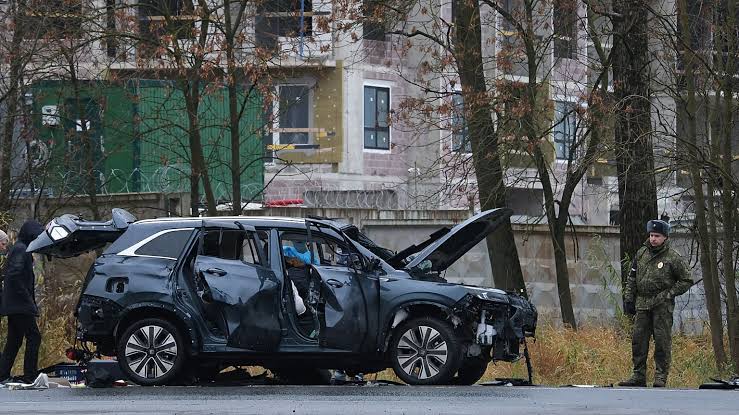
A deadly explosion renews scrutiny of Russia’s internal security.
ST. PETERSBURG, Russia. A Russian military officer was killed when his vehicle exploded in St. Petersburg on November 12, prompting a murder investigation amid a series of attacks targeting military personnel since Russia launched its full-scale invasion of Ukraine in 2022. Authorities confirmed the death but had not officially identified the victim or established who was responsible for the explosion.
Russia’s Investigative Committee reported that the incident occurred in the city’s Pushkinsky district, where forensic specialists and law enforcement officers began examining the scene. Investigators ordered technical examinations to determine the circumstances surrounding the explosion and identify those potentially involved.
Russian media identified the location more precisely as Shushary, near Kolpinskoye Highway, and reported that the victim was a colonel serving as chief navigator of the 6th Air and Air Defence Army. His identity and military position had not been formally confirmed by investigators.
According to the St. Petersburg news outlet Fontanka, an explosive device had been attached beneath the officer’s vehicle and was detonated remotely shortly after he began driving. The explosion reportedly killed him at the scene and damaged a nearby passenger bus. Surveillance footage captured the blast, although the complete sequence of events remains subject to investigation.
Russian media also reported that a suspected perpetrator had fled the country. Details concerning the suspect’s identity and the alleged preparations for the attack had not been independently verified, and authorities had not publicly established a motive.
The incident follows another fatal explosion in the same area on August 27, when a Russian lieutenant colonel was killed and his wife seriously injured. That earlier attack also involved an explosive device, but investigators have not publicly demonstrated a connection between the two cases.
St. Petersburg’s latest bombing adds to a succession of violent incidents involving Russian military officials since the beginning of the war in Ukraine. Several senior officers have been killed in explosions or shootings, drawing attention to the risks faced by personnel associated with Russia’s military operations.
Among the most prominent cases was the December 2024 killing of Lieutenant General Igor Kirillov, head of Russia’s radiation, chemical and biological protection forces. An explosive device concealed near a residential building in Moscow killed Kirillov and his assistant. A Ukrainian security source subsequently claimed responsibility for the operation, while Russian authorities described the killing as terrorism.
In April 2025, Lieutenant General Yaroslav Moskalik was killed in a vehicle explosion near Moscow. Another senior officer, Lieutenant General Fanil Sarvarov, died in a car bombing in the Russian capital in December of that year.
These incidents have intensified debate over the ability of Russian security agencies to protect military officials away from active combat zones. Attacks involving personnel in residential neighborhoods also create risks for civilians and surrounding infrastructure.
Moscow has repeatedly accused Ukrainian intelligence services of organizing operations against Russian military personnel. Ukrainian authorities have acknowledged involvement in certain previous attacks but have not claimed responsibility for the latest St. Petersburg explosion.
That distinction remains essential. Similarities between incidents, including the use of explosives and the military status of victims, do not establish that they were organized by the same individuals or institutions. Investigators must determine whether the latest killing involved a coordinated operation, a separate criminal act or another motive.
The security implications extend beyond the identity of the perpetrator. Military institutions depend on protecting personnel, maintaining operational continuity and limiting vulnerabilities that can be exploited outside conventional battlefields. The killing of officers far from the front line raises questions about the intersection of military conflict, intelligence operations and domestic law enforcement.
The investigation also takes place against the backdrop of a prolonged war that has affected the security environment in both Russia and Ukraine. As hostilities continue, incidents beyond the battlefield contribute to uncertainty about how far the conflict’s consequences may extend into civilian areas.
For Russian authorities, the immediate task is identifying the perpetrator and establishing the circumstances of the explosion through verifiable evidence. Until those findings emerge, responsibility for the attack remains unresolved.
The death of another military officer in St. Petersburg illustrates how the consequences of the war increasingly extend beyond conventional combat, while the unanswered questions surrounding the bombing demonstrate the importance of distinguishing established facts from allegations and speculation.
Beyond the Headlines, Accountability Matters.