

 Phoenix 24
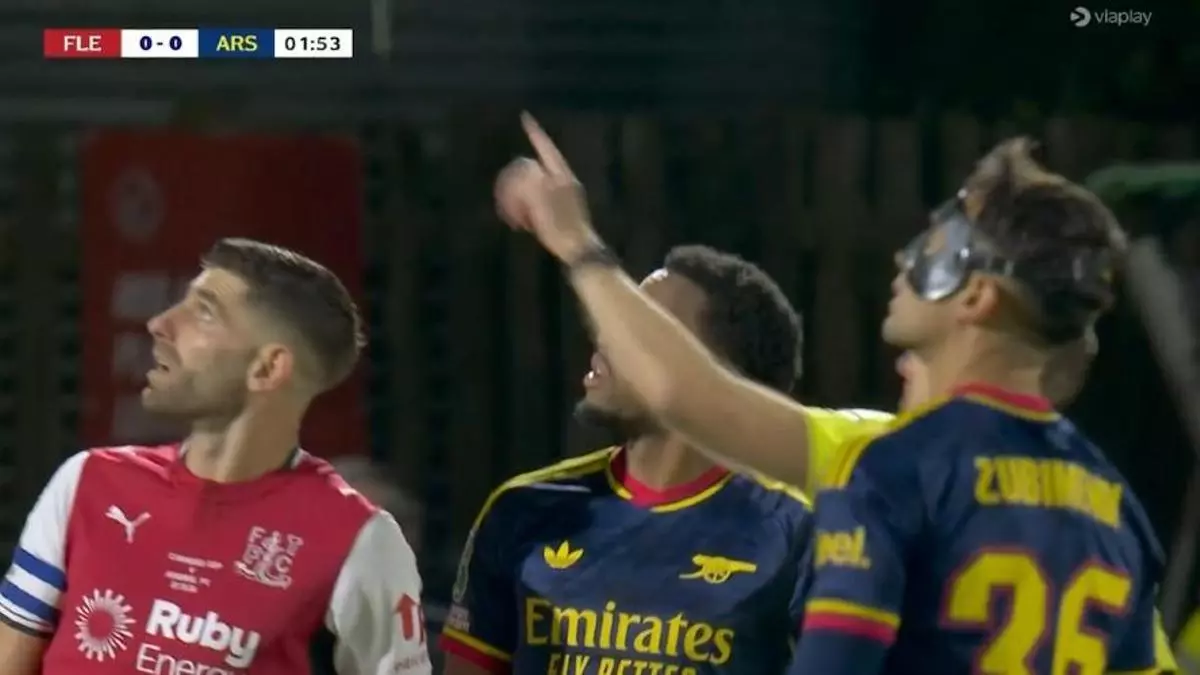
An unexpected security scare preceded a stunning football upset.
FLEETWOOD, ENGLAND.
Arsenal’s Carabao Cup encounter with Fleetwood Town was temporarily suspended on Tuesday evening after an unauthorized drone appeared above the pitch at Highbury Stadium, forcing match officials to interrupt play and initiate security procedures. The unusual incident delayed the fourth-round fixture for approximately eight minutes before competition resumed, setting the stage for an extraordinary evening in which the fourth-tier hosts ultimately eliminated the Premier League champions on penalties.
Referee Michael Salisbury first stopped play with less than two minutes on the clock after the drone was spotted hovering over the playing area. Arsenal had been preparing to take a free kick when the official became aware of the aircraft and began consulting club representatives and stadium personnel. With the origin and purpose of the device initially unknown, Salisbury decided that the match could not continue safely.
The interruption created confusion inside Fleetwood’s compact stadium. Players initially remained on the pitch, keeping warm while officials assessed the situation. Salisbury subsequently instructed both teams to leave the field temporarily, as supporters expressed frustration at the unexpected delay. Police were informed, and stadium authorities worked to establish whether the aircraft posed an immediate threat.
Television commentary subsequently indicated that police had located the drone operator outside the ground. The aircraft moved away from the stadium, allowing officials to authorize the resumption of play. The match restarted with approximately ten minutes showing on the game clock, without requiring the fixture to be postponed or abandoned.
The incident highlighted the operational challenges posed by small unmanned aircraft at sporting venues. Although drones are widely used for photography, filming and recreational activities, unauthorized flights above crowded stadiums create safety concerns. Mechanical failure, loss of control or interference with other equipment can expose players, officials and spectators to potentially dangerous situations.
English football guidance recognizes these risks. Match officials are advised to stop play when a drone is observed above or near a football pitch and to consult the participating teams before deciding whether conditions permit the game to continue. Where an aircraft remains in the vicinity, players may be instructed to return to their dressing rooms until the situation has been resolved.
Salisbury’s decision was therefore consistent with established safety procedures rather than an exceptional disciplinary intervention. The referee did not need to establish that the drone was being operated maliciously before taking precautionary action. The presence of an unidentified aircraft over the playing area was sufficient to justify an interruption while the risk was assessed.
The available information does not establish why the operator flew the drone near Highbury Stadium or whether any formal enforcement action followed. Reports that police located the individual should not be interpreted as confirmation of criminal intent, deliberate disruption or a specific violation of aviation regulations without further evidence.
Once play resumed, attention returned to a contest carrying substantial significance for Fleetwood Town. The League Two club, competing in the fourth tier of English professional football, had reached the last 16 of the competition for the first time. Facing Arsenal, one of England’s most prominent clubs, presented both a formidable sporting challenge and an opportunity to achieve a memorable result.
Fleetwood entered the match as a considerable underdog. The difference in resources, squad depth and competitive experience between the two clubs was substantial, while Arsenal’s position among the Premier League’s leading teams reinforced expectations that the visitors would progress.
Those assumptions were challenged almost immediately after the restart. In the 21st minute, Fleetwood forward Aaron Loupalo-Bi exploited space in Arsenal’s defence, overcame the challenge of Marli Salmon and fired past goalkeeper Illan Meslier to give the hosts a remarkable lead.
The goal transformed the atmosphere at Highbury. What had begun as an unusual evening because of the security interruption became a genuine cup contest, with Fleetwood demonstrating the aggression and determination required to challenge superior opposition.
Arsenal responded after halftime through Viktor Gyökeres, who equalized from close range following an attacking move involving Piero Hincapié and debutant Ceadach O’Neill. The goal appeared to restore the expected competitive balance, but Fleetwood continued defending effectively and resisted sustained pressure.
The visitors’ challenge became more complicated when teenage prospect Max Dowman was sent off following an altercation with Fleetwood’s Harrison Neal. The dismissal reduced Arsenal to ten players during the closing stages, making the task of securing victory increasingly difficult.
Despite opportunities to settle the match in regulation time, neither side found another goal. Fleetwood goalkeeper Jay Lynch made an important intervention to deny Ben White, helping the hosts preserve the 1-1 scoreline and force a penalty shootout.
The decisive moment arrived when Lynch saved Arsenal’s fourth penalty, taken by Bruno Guimarães. Fleetwood maintained their composure from the spot, and Conor Haughey converted the winning attempt to complete a 5-3 shootout victory.
The result secured Fleetwood’s passage into the quarter-finals and represented one of the most significant achievements in the club’s competitive history. Supporters celebrated an outcome that had appeared highly improbable before kickoff, with the smaller club overcoming its opponent through disciplined defending, resilience and effective penalty execution.
For Arsenal, the elimination raised questions about squad rotation, defensive organization and the team’s ability to manage knockout matches against lower-division opposition. Manager Mikel Arteta had selected a changed lineup, providing opportunities to younger players while maintaining the expectation that Arsenal could advance.
The outcome demonstrated the uncertainties inherent in domestic cup competitions. Differences in league position and financial resources influence expectations, but they do not determine individual results. A lower-division side can create opportunities through tactical discipline, effective finishing and the ability to withstand pressure during decisive moments.
Yet the evening’s opening incident also deserves attention independently of the sporting result. The drone interruption exposed how a relatively small device can affect an event involving professional athletes, spectators, broadcasting operations and stadium security personnel.
Modern sporting venues increasingly rely on coordinated security arrangements extending beyond conventional access controls. Physical barriers, ticketing systems and crowd management procedures remain essential, but airborne devices introduce potential risks that are more difficult to address through traditional stadium infrastructure.
The challenge is partly technological and partly organizational. Detecting an aircraft does not automatically establish who is operating it, whether it has permission to fly or what risks it presents. Officials must therefore make decisions under uncertainty, balancing the importance of continuing an event against their responsibility to protect those involved.
For football authorities, incidents of this kind reinforce the value of clear procedures and communication between referees, stadium operators and police. Rapid coordination can reduce unnecessary delays while ensuring that competition does not resume before the immediate concern has been addressed.
The distinction between a temporary suspension and an abandoned match is particularly important. A suspension allows officials to interrupt proceedings while preserving the possibility of continuing under safe conditions. Abandonment involves terminating the fixture before completion, with further consequences determined by competition regulations.
At Fleetwood, the situation was resolved quickly enough to avoid the need for further scheduling decisions. The interruption lasted only a few minutes, but its significance extended beyond the duration of the delay.
The match ultimately became memorable for two different reasons. The unexpected appearance of a drone brought an immediate security challenge to the attention of officials, while Fleetwood’s subsequent victory demonstrated the enduring unpredictability of knockout football.
Neither development should be confused with the other. There is no established evidence that the drone incident caused Arsenal’s defeat or materially determined the match’s competitive outcome. Fleetwood’s qualification resulted from the goals, defensive performances and penalty shootout that followed the interruption.
The evening nevertheless illustrated how professional sport increasingly operates at the intersection of competition, public safety and technological change. A device that can be operated from outside a stadium temporarily interrupted a nationally televised fixture, requiring coordinated intervention before thousands of spectators could watch the match continue.
For Fleetwood, the lasting memory will be the elimination of a Premier League powerhouse and a historic place in the Carabao Cup quarter-finals. For match organizers and security authorities, the incident offers a separate reminder that emerging technologies can create operational challenges even when they appear small or familiar.
What began as an unexpected interruption became an extraordinary sporting occasion. The drone briefly stopped the football, but Fleetwood’s performance ultimately became the defining story of a night when established expectations were overturned.
Behind Every Fact, a Deeper Story.