

 Phoenix 24
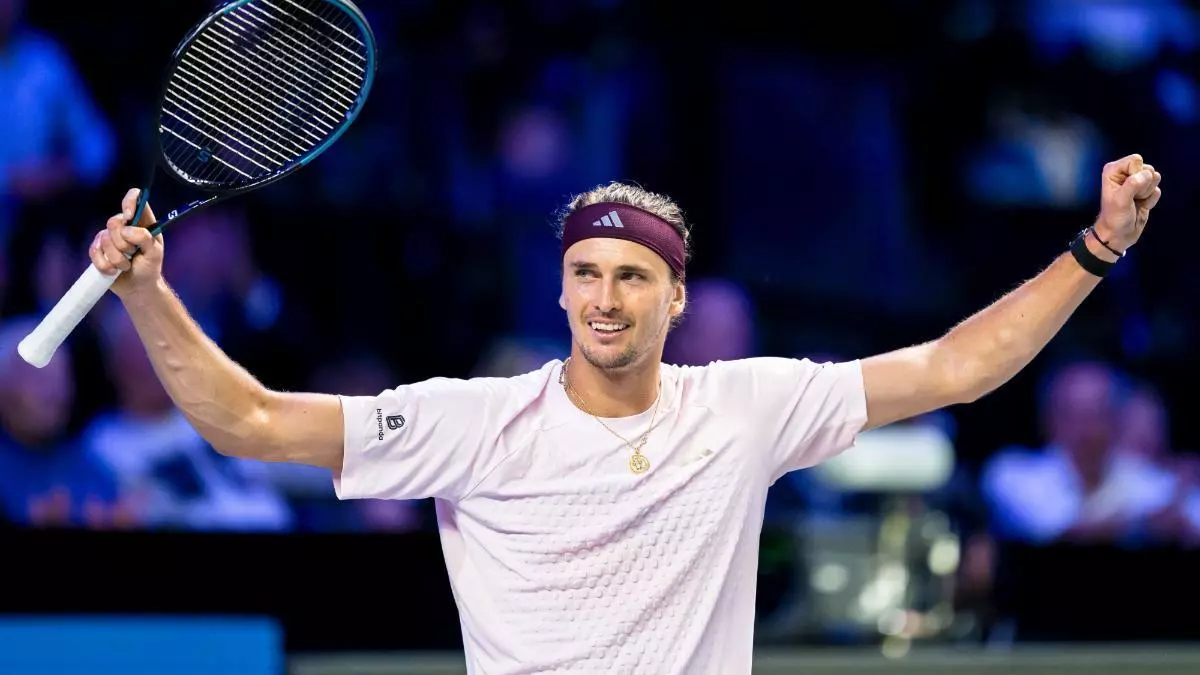
An extraordinary comeback keeps the world number one within reach.
VIENNA, AUSTRIA.
Alexander Zverev survived four match points against Spanish rising star Martín Landaluce to secure a dramatic first-round victory at the Vienna Open on Tuesday, escaping one of the most demanding encounters of his season. The German, ranked second in the world, recovered from a precarious position in the deciding tiebreak to win 7-5, 3-6, 7-6 (13-11) after three hours and five minutes, preserving his opportunity to reach the top of the ATP rankings.
The result represented considerably more than a routine victory for the tournament’s leading seed. Zverev, 29, entered the competition with a clear mathematical opportunity to overtake the injured Jannik Sinner as world number one. Yet his opening match nearly ended in elimination against a 20-year-old opponent who demonstrated remarkable composure, aggressive baseline tennis and an ability to challenge one of the sport’s most established competitors.
Landaluce, ranked 67th and competing with a wildcard invitation, approached the encounter without allowing the difference in ranking or experience to dictate his performance. The Madrid-born player repeatedly pressured Zverev from the baseline, using the depth of his groundstrokes and a forceful forehand to disrupt the German’s rhythm. His ability to compete effectively on the tournament’s fast indoor hard courts established the conditions for an unexpectedly close contest.
The first set revealed the competitive balance that would define the match. Landaluce remained within reach of Zverev throughout the opening exchanges, responding to the German’s powerful serve with confident returns and sustained aggression. At 5-5, however, Zverev increased his intensity, broke his opponent’s serve and consolidated the advantage to take the set 7-5.
Losing the opening set did not diminish Landaluce’s ambition. He began the second with renewed aggression, breaking early and establishing a 3-0 lead. His groundstrokes forced Zverev into defensive positions, while his service games demonstrated the control necessary to protect an advantage against a player accustomed to competing in the closing stages of major tournaments.
Zverev struggled to recover his usual authority from the baseline, allowing the Spaniard to dictate numerous exchanges. Landaluce maintained his concentration and closed the second set 6-3, forcing a decider that increasingly exposed the tension between the German’s championship ambitions and his opponent’s determination to secure a career-defining victory.
The final set produced another prolonged contest. Both players protected their service games through demanding exchanges, while opportunities to break became increasingly consequential. Zverev faced pressure early in the set but escaped a break point, and Landaluce continued responding with the attacking tennis that had brought him level.
As the score approached its decisive stages, neither player established a lasting advantage. Zverev created opportunities to end the match before the tiebreak, but the Spaniard saved two match points while serving to remain in contention. The escape demonstrated Landaluce’s resilience and ensured that the encounter would be decided through one of tennis’s most psychologically demanding formats.
The decisive tiebreak initially appeared to favor the younger player. Landaluce raced to a 5-2 lead, placing Zverev under immediate pressure and bringing the possibility of a major upset within reach. The German responded by narrowing the deficit, but Landaluce continued creating opportunities to finish the contest.
Four match points ultimately came and went for the Spaniard. Each represented an opportunity to defeat the world number two and record the most significant victory of his professional career. Zverev survived through a combination of defensive resistance, reliable serving and the ability to manage critical points, while Landaluce struggled to convert the advantage into a final winning shot.
The tiebreak extended beyond the conventional seven-point target as neither competitor could establish the required two-point margin. Zverev eventually closed it 13-11 on his fifth match point, ending a contest that had repeatedly threatened to overturn the expectations surrounding the tournament.
The emotional contrast was immediate. Landaluce, visibly distressed after the defeat, covered his face with a towel while attempting to process how closely he had come to victory. Zverev approached the Spaniard at the net and embraced him, acknowledging the quality of an opponent who had forced him to confront elimination on four separate occasions.
The gesture reflected the respect established during an encounter in which ranking positions offered little protection from competitive pressure. Landaluce had not merely benefited from a disappointing performance by the favorite. He had produced sustained periods of high-quality tennis, forcing Zverev to respond to the level of a younger player increasingly capable of challenging established opponents.
After the match, Zverev acknowledged that he had not produced his strongest tennis and praised Landaluce’s serving and overall performance. The German recognized the exceptional difficulty of the contest, while emphasizing the importance of remaining composed when facing match points. His assessment reflected both the relief of surviving and an awareness that similar inconsistency could prove costly later in the tournament.
For Landaluce, the defeat adds another demanding experience to a season marked by his efforts to establish himself at a higher competitive level. His development has been supported by the Rafa Nadal Academy and a coaching structure focused on refining the technical and tactical qualities required for sustained success on the ATP Tour.
The Spaniard’s performance in Vienna demonstrated that he possesses the ability to challenge elite opponents over an extended match. His service effectiveness, baseline aggression and willingness to compete under pressure were particularly significant. The unresolved challenge lies in converting those qualities into victories when the opportunity arrives.
That distinction is often decisive in professional tennis. Competing effectively against a leading player requires technical ability and physical endurance, but closing a match introduces another dimension. The emotional weight of a potential breakthrough can influence shot selection, risk assessment and execution, particularly when a younger competitor recognizes the magnitude of the occasion.
Landaluce’s inability to convert four match points does not diminish the quality of his overall performance. It does, however, identify a critical stage in his competitive development. Learning to manage opportunities against highly experienced opponents will become increasingly important as he seeks to progress through the rankings.
The Vienna encounter also illustrates why ranking differences do not always translate into predictable results. A top player may possess greater experience, superior statistical consistency and a record of success against elite competition, yet individual matches remain sensitive to playing conditions, confidence and moment-to-moment execution.
For Zverev, the implications extend directly to the ATP rankings. He entered Vienna knowing that reaching the quarterfinals would allow him to overtake Sinner and secure the world number one position. With the Italian sidelined by injury, the German has an opportunity to finish the season at the top of men’s tennis, provided he completes the necessary results.
His victory over Landaluce moves him into the second round, where he will face either Tallon Griekspoor of the Netherlands or American Brandon Nakashima. A further victory would secure his place in the quarterfinals and, according to the ranking calculations surrounding the tournament, deliver the number one position.
The opportunity carries considerable significance for a player whose career includes major tournament victories and extensive experience competing near the top of the rankings. Reaching world number one would represent another milestone, but Tuesday’s performance demonstrated that mathematical possibilities do not eliminate the immediate demands of competition.
Zverev must also consider the physical consequences of a three-hour opening match. Although he demonstrated resilience during the final stages, the prolonged encounter required substantial energy at a time when recovery between matches becomes increasingly important. His ability to regain consistency and manage the demands of consecutive rounds may influence the remainder of his campaign.
Vienna’s fast indoor conditions reward effective serving, precise returns and the ability to control short exchanges. Zverev possesses the technical resources to succeed in that environment, having previously won the tournament in 2021. Yet the challenge presented by Landaluce showed that those advantages can be neutralized when an opponent plays aggressively and maintains sufficient consistency.
The encounter ultimately produced two different outcomes with significant implications. Zverev preserved his pursuit of the world number one ranking, escaping a defeat that would have interrupted his immediate objective. Landaluce left the tournament without advancing, but with evidence that he can sustain a competitive challenge against one of the sport’s leading players.
Their meeting also exposed an important distinction between experience and potential. Zverev relied on the composure developed through years of competing in high-pressure situations, while Landaluce demonstrated the technical and competitive qualities that could support further progress. The result favored the established player, but the contest offered valuable insight into the younger competitor’s trajectory.
For the German, Vienna remains an opportunity to convert a favorable ranking scenario into a significant professional achievement. For the Spaniard, the disappointment of four missed match points may eventually become a reference point in understanding the demands of elite competition.
Tennis often reduces extraordinary contests to a final score, yet this match cannot be understood through the result alone. Zverev’s survival preserved his championship ambitions, while Landaluce’s performance revealed the narrow margins separating a promising young player from a breakthrough victory.
The German advanced because he found a way to win when defeat appeared imminent. The Spaniard departed after demonstrating that the distance between emerging talent and established excellence can be considerably smaller than the rankings suggest.
Beyond the Headlines, the Pattern.