

 Phoenix 24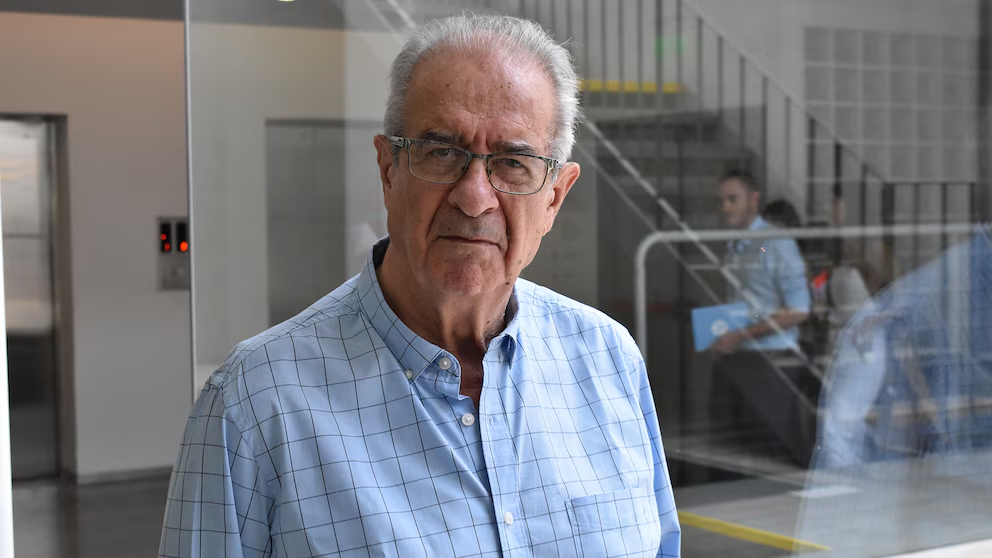
A lifetime of scholarship turns history into public memory.
Buenos Aires
Argentine sociologist and historian Juan Carlos Torre has been awarded the 2026 Konex de Brillante in Humanities, the highest distinction granted by the Fundación Konex in the field. The award recognizes him as the most outstanding figure of the 2016 to 2025 decade across the humanities, consolidating a career that has moved between academic research, political history and first hand observation of Argentina’s democratic transition. The ceremony will take place on November 3 at the Faculty of Law of the University of Buenos Aires.
Born in Bahía Blanca in 1940, Torre studied Sociology at the University of Buenos Aires and later earned a doctorate at the École des Hautes Études en Sciences Sociales in Paris. His academic work has focused on Argentine social and political history, particularly labor movements, trade unionism and the origins of Peronism. He is professor emeritus at Universidad Torcuato Di Tella and directed the journal Desarrollo Económico between 1993 and 2018.
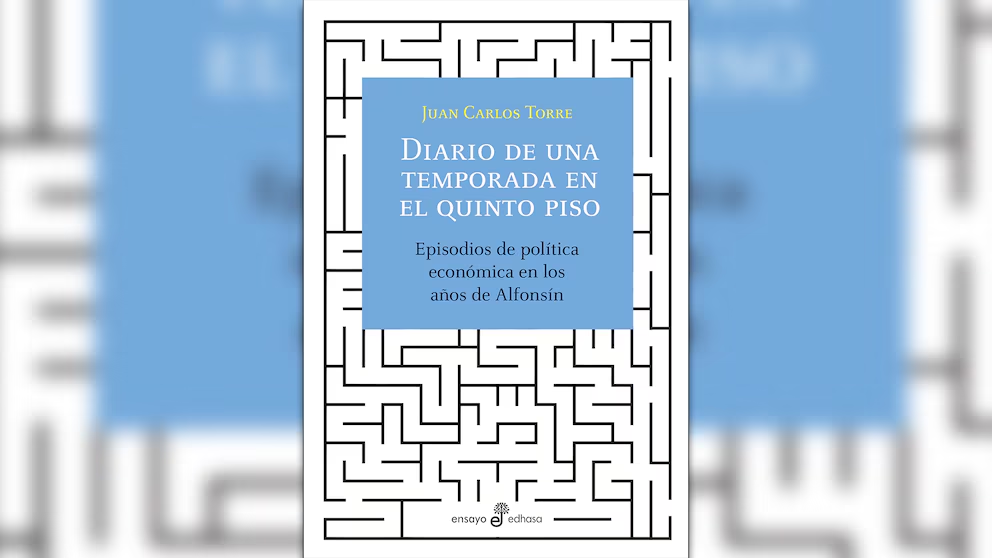
One work, however, gave Torre an unusual place beyond academia. Diario de una temporada en el quinto piso reconstructs his experience inside Argentina’s Ministry of Economy during the government of Raúl Alfonsín, combining personal observation with analysis of the economic and political tensions that defined the first years after the restoration of democracy. Published in 2021, the book became an important reference for understanding how economic decisions were negotiated from inside government during a period marked by institutional recovery and repeated stabilization efforts.
The Konex distinction also recognizes the broader intellectual ecosystem in which Torre has worked. The 2026 awards include figures from philosophy, psychology, sociology, economics, law, education and political science, while Beatriz Sarlo received the Konex de Honor posthumously. Torre was chosen for the top award by a Grand Jury chaired by jurist Aída Kemelmajer de Carlucci.
His recognition is significant because it rewards more than disciplinary specialization. Torre’s career demonstrates how sociology and history can illuminate the institutional choices, conflicts and pressures that shape political life from within. His work has repeatedly connected archival rigor with lived experience, turning episodes of Argentine history into analytical material for later generations.

The Konex de Brillante therefore closes no chapter. It confirms that scholarship can remain influential when it succeeds in explaining not only what happened, but how decisions were made when history was still unfolding.
Detrás de cada dato, la intención. / Behind every data point, the intention.